The Museum
Spring 2013 Exhibitions
The Path of Nature:
French Paintings from the Wheelock Whitney
Collection, 1785-1850
January 22–April 21, 2013
Sleeping Eros
January 29 - June 23, 2013
Birds in the Art of Japan
February 2-July 28, 2013
Cambodian Rattan: The Sculptures
of Sopheap Pich
February 23-June 16, 2013
Plain or Fancy? Restraint and
Exuberance in the Decorative Arts
February 26–August 18, 2013
At War with the Obvious:
Photographs by William Eggleston
February 26 – July 28, 2013
Impressionism, Fashion, and
Modernity
February 26 – May 27, 2013
Photography and the American Civil
War
April 2 – September 2, 2013
Making the Invisible Visible
April 2 - August 4, 2013
The Civil War and American Art
May 28 – September 2, 2013
PUNK: Chaos to Couture
May 9–August 11, 2013
Search for the Unicorn: An
Exhibition in Honor of The Cloisters’ 75th
Anniversary
May 15 - August 18, 2013
Ken Price Sculpture: A
Retrospective
June 18 – September 22, 2013
NEW EXHIBITIONS:
Metropolitan
Museum Exhibition Examines Changing Image of Eros,
Ancient Greek God of Love, from Antiquity to Renaissance
Exhibition Dates: January 29-June 23, 2013
Exhibition Location: Greek and Roman Special Exhibitions
Gallery, Room 172 (mezzanine level)
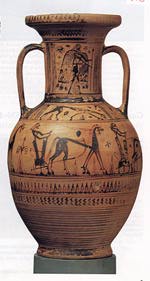
In Greek mythology, Eros was the god of love. He
was capable of overpowering the minds of all gods and all
men. Literary sources of the sixth and fifth centuries
B.C. portrayed him as a powerful, often cruel, capricious
being, and in classical Greek art Eros was usually
represented as a winged youth. A radically different
visual image of Eros—as a charming, winged child asleep on
a rock—was introduced centuries later by Hellenistic
artists. The Metropolitan Museum of Art’s statue of Eros
Sleeping—one of the finest of the surviving bronze
statues from classical antiquity—will be the focus of the
special exhibition Sleeping Eros,
opening January 29, 2013.
The exhibition is made possible by The Vlachos Family Fund.
Eros Sleeping will be shown with 46 related
works of art in various media, ranging in date from the
fifth century B.C. to the 17th century A.D., drawn
primarily from the Museum’s permanent collection. Two
works from private collections will also be shown.
Through these examples, the exhibition will examine the
cult and image of Eros before and after the Sleeping Eros
statue type, show the breadth of its influence, and trace
the wide dispersal of the type in Roman times and its
subsequent rediscovery during the Renaissance. The
exhibition will also consider the original function and
context of the sculpture, how the statue was made, and the
issue of originals and copies in Greek and Roman
sculpture.
The Sleeping Eros was among the earliest types of ancient sculpture to be rediscovered during the Italian Renaissance, and it was the subject of numerous figural studies by Renaissance and Baroque artists in Italy—including Michelangelo, among many others—who were looking to the classical tradition for training and inspiration. Some works were close likenesses, such as the fine Drawing of a Sleeping Eros after an antique sculpture by Giovanni Angelo Canini (1617–1666), which will be shown in the exhibition. Other, less literal, adaptations will also be displayed.
In 1943, when the Metropolitan Museum acquired its statue of Eros Sleeping, it was believed to be an original Hellenistic sculpture or a very close replica created between 250 and 150 B.C. Subsequently, some scholars have suggested that it is a very fine Roman copy of one of the most popular sculptures ever made in Roman Imperial times. Recent research—to be presented in the exhibition—supports the former identification, but also makes apparent that it was restored in antiquity—most likely in the Early Imperial period.
Details of the research will also be published in an upcoming article in the Metropolitan Museum’s annual Journal.
A public lecture by the curator on Friday, April 5, 2013, and gallery talks will be offered in conjunction with the exhibition.
Additional information about the exhibition and its accompanying programs can be found on the Museum’s website at www.metmuseum.org.
The exhibition is organized by Seán Hemingway,
Curator, Department of Greek and Roman Art. Exhibition
design is by Michael Batista, Exhibition Design Manager;
lighting is by Clint Ross Coller and Richard Lichte,
Lighting Design Managers; graphics are by Mortimer
Lebigre, Associate Graphic Designer, all of the Museum’s
Design Department.
Major
Exhibition on Theme of Nature in Western Art
to Open at National Museum of China in Beijing
on February 1
A major exhibition of masterworks from the
world-renowned collection of The Metropolitan Museum
of Art, New York, will be on view at the National
Museum of China in Beijing from February 1 through May
9, 2013. The exhibition, Earth, Sea, and
Sky: Nature in Western Art – Masterpieces from The
Metropolitan Museum of Art, explores the
grand theme of nature as it has been depicted by
painters, sculptors, and decorative artists in Europe,
America, and the Near East, from antiquity to the
present day. The 130 works of art are drawn from
the Metropolitan Museum’s vast encyclopedic holdings,
and they are masterful representations of landscape,
flora, and fauna rendered in a wide range of media
including painting, ceramics, tapestry, silver, stone,
and bronze. Highlights include works by such major
artists as Rembrandt, Van Gogh, Monet, Tiffany,
Hopper, and Atget, as well as anonymous masters from
the ancient and medieval worlds.
Thomas P. Campbell, the Metropolitan Museum’s Director
and CEO, stated: “Never before has an exhibition of
this scope and theme, drawn entirely from the Met’s
holdings, traveled to China. We are pleased that this
wonderful collaboration—a milestone in the cultural
exchange between China and the United States—is taking
place at the National Museum of China, one of the
great museums of China and one of the leading cultural
attractions in the world. The works of art in Earth, Sea, and Sky
will not only acquaint the Chinese public with these
masterpieces first-hand, but will also introduce them
to the breadth and quality of the Met’s collections.”
Mr. Lv Zhangshen, President of the National Museum of
China, stated, “This exhibition marks another
milestone of international collaboration for the
National Museum of China after the completion of the
new museum building, following the success of the Art
of the Enlightenment exhibition in cooperation
with the three major national museums in Germany; Passion
for Porcelain: Masterpieces of Ceramics from the
British Museum and the Victoria and Albert Museum; and
Renaissance in Florence: Masterpieces and
Protagonists in collaboration with the Italian
Ministry of Cultural Heritage and Activities. It is
also the very first time that The Metropolitan Museum
of Art is showcasing its masterpieces in China. It is
expected that the number of works and the academic
depth of this exhibition will have a sensational
effect. In the past, Chinese audiences have been able
to learn about these great art pieces through
publications; but now they will be able to experience
and appreciate the charm of these original works in
China. Clearly, this exhibition will have great
significance in promoting cultural communication and
the popularization of art.
The exhibition was organized by The Metropolitan
Museum of Art, New York, in collaboration with The
Yomiuri Shimbun and The Tokyo Metropolitan Art Museum.
Exhibition Description
The works of art on view, which date from the third
millennium B.C. to the 20th century, are organized
thematically in the exhibition and accompanying
catalogue, in order to bring out engaging and
informative juxtapositions. The sections are: Nature
Idealized, The Human Presence in Nature, Animals,
Flowers and Gardens, Nature in the Camera Lens,
Earth and Sky, and Watery World.
Nature Idealized presents visions of nature
inspired by ideas, literary sources, and abstract
notions. This section includes Arcadian
landscapes that are shaped as much by ideals of a
golden classical past as by the world before the
artists’ eyes. Some of artists personified
aspects of nature, representing them with the human
form. The great artist Rembrandt (Dutch,
1606–1669) depicted Flora, the goddess of
springtime, flowers, and love, in his eponymous
painting of 1654, using his beloved deceased wife
Saskia as his model.
In The Human Presence in Nature, landscape is
the setting for the lives people live and the stories
they tell. The natural environment is inhabited by men
and women, and is shaped by farming and hunting.
An ancient Egyptian stone relief of grain (ca.
1349–1336 B.C) speaks eloquently to human agriculture
and the staff of life. A medieval tapestry
(1500–1530) weaves a colorful story of love among
peasant shepherds. And a painting by Renoir
(French, 1841–1919) celebrates the sparkling sea and
two ladies at leisure in Figures on the Beach.
The creatures on view in the third section, Animals,
span the full chronological and geographic breadth of
the exhibition. From the bronze head of a bull from
ancient Mesopotamia (ca. 2600–2350 B.C.) to a sleek
marble polar bear from the 20th century, these beasts
speak to the close relationships between humans and
the other creatures that inhabit their world.
Known in the West as the King of Beasts, the lion is
featured in many of the works in the exhibition,
including an aquamanile (water vessel) and a military
helmet, both from the 15th century.
A garden is nature shaped by human hands. In the
section Flowers and Gardens, we see the way
artists have celebrated the pure beauty of
nature. Two very different glass vases by Louis
Comfort Tiffany (American, 1848–1933) exemplify the
way artists are inspired by flowers and yet transform
them in the course of their creative process.
Nature in the Camera Lens differs from all of
the other sections of the exhibition in its focus on a
single medium, photography. In this one
technological form all the themes of the exhibition
are recapitulated, from idealized landscapes to
flowers and animals. The final image in this
section—a masterwork of the last decade of the 20th
century by Hiroshi Sugimoto (Japanese, born
1948)—reduces nature to its most elemental: a simple
horizon marking sea and sky.
The sixth section, Earth and Sky, focuses on
landscape, especially images of trees, mountains, and
sky. Here, differing artistic conceptions of
landscape—some grandiose, some intimate—are
shown. A highlight is Cypresses (1889)
by Vincent van Gogh (Dutch, 1853–1890); it is a
painterly, turbulent representation of a tree in
Provence that he observed to be “as beautiful of line
and proportion as an Egyptian obelisk.”
The final section, Watery World, focuses on
seascapes, waterfalls, rivers, and other bodies of
water, along with depictions of fish and other animals
that live in liquid environments. One such
creature is the octopus, seen stretching his arms
around a Mycenaean vessel from between 1200 and 1100
B.C. And in Venice, from the Porch of Madonna
della Salute, Joseph Mallord William Turner
(English, 1775–1851) captures the atmospheric shimmer
of water.
The exhibition Earth, Sea, and Sky includes
loans from 12 of the Metropolitan Museum’s 17
curatorial departments. Because a goal of the
exhibition is to present works of art from traditions
that may be less familiar to Chinese audiences, loans
were selected only from those departments with
holdings of art of the Western tradition.
Exhibition and Catalogue Credits
Earth, Sea, and Sky was conceived and
organized by Peter Barnet, the Michel David-Weill
Curator in Charge of Medieval Art and The Cloisters at
The Metropolitan Museum of Art. Mr. Barnet is also the
author of the exhibition catalogue’s introductory
essay, which tells the story of the founding and the
history of the Metropolitan Museum, as well as an
explication of the themes covered by the exhibition.
Organization of the exhibition included the assistance
of Wendy A. Stein, Research
Associate. Catalogue entries for the works of art were
written by 40 curators and other scholars at the
Metropolitan Museum.
The exhibition catalogue is being published in
Mandarin by the National Museum of China in Beijing.
==================================================
Bird-themed
Exhibition Goes on View at Metropolitan
Museum Beginning February 2
Exhibition dates: February 2,
2013–July 28, 2013
Location: The Sackler Wing Galleries for the
Arts of Japan, 2nd floor Galleries 225–31
“It was evening all afternoon. It was
snowing And it was going to snow. The
blackbird sat In the cedar-limbs.” From
Thirteen Ways of Looking at a Blackbird by
Wallace Stevens
Showcasing some 150 works in various media from
medieval times to the present, the exhibition Birds
in the Art of Japan at The
Metropolitan Museum of Art will explore how Japanese
artists have depicted bird species of every
variety—from monochromatic ravens, crows, and mynah
birds to colorful peacocks, long-tailed cocks, and
magpies. Highlights of the exhibition, which opens
February 2, 2013, include such masterpieces as a
pair of screens depicting a flock of mynah birds and
four enormous paintings of birds of prey by Kawanabe
Kyōsai (1831–1889). Among the contemporary works in
the exhibition will be graphically potent
black-and-white photographs from the celebrated Solitude
of Ravens series by the late Fukase Masahisa
(1934–2012). Displays of paintings will be
juxtaposed with examples of modern and contemporary
textiles, ceramics, lacquerware, and bamboo
art. Drawn mostly from the Metropolitan’s own
collection, including important recent acquisitions,
the exhibition also presents some 15 objects from
private collections—several of these loans will be
displayed publicly in this exhibition for the first
time.
The exhibition is made possible by The Miriam and
Ira D. Wallach Foundation.
“Inspiration for the exhibition comes from
traditional Japanese court poetry and haiku as well
as a famous poem by Wallace Stevens,” said John
Carpenter, Curator of Japanese Art in the
Metropolitan Museum’s Department of Asian Art.
“Stevens’s Thirteen Ways of Looking at a
Blackbird comprises 13 haiku-like stanzas and
alludes to various moods associated with viewing
blackbirds. Several of the stanzas can be considered
to evoke emotions comparable to a superb set of
Kyōsai album paintings of crows and other birds, 13
of which will be included in this exhibition.”
Japanese artists from the earliest times have
depicted birds—real and fanciful—often with
literary, religious, or auspicious connotations
drawn from Chinese precedents. Screen and
sliding-door paintings with bird-and-flower themes,
in both ink and brilliant colors, were created
frequently for ancient palaces or temple settings
and have remained popular with artists of every
school through the Edo period (1615–1868).
The exhibition is organized roughly by type of bird. The opening gallery will focus on the poetic associations and auspicious symbolism of cranes in East Asian art as a symbol of long life, and as the frequent companion of Daoist immortals. Highlights of the section are a dramatic set of screens by Ishida Yūtei (1721–1786), with a flock of cranes in various poses, and a tour-de-force example of contemporary bamboo sculpture by Honma Hideaki (b. 1959) called Flight, which captures the aerodynamic elegance and sense of liberation of a soaring bird.
The next section will begin with medieval ink paintings, such as hanging scrolls with meticulous depictions of waterfowl, and the 17th-century gold-leaf screen with an autumnal scene of ripe millet and a flock of small birds. These views of birds in serene settings will contrast with the works that follow—a quartet of dramatically scaled paintings by Kawanabe Kyōsai showing eagles attacking various types of prey, like monkeys, rabbits, and squirrels. A monumental iron sculpture of an eagle with an almost five-foot wing span will represent the accomplishments of late 19th-century metalworkers. A rare hammered-iron raven, signed by the early 18th-century master swordmaker and metalsmith Myōchin Munesuke (1642–1735?), will also be on view.
One of the centerpieces of the exhibition will be a pair of early-17th-century screens depicting a flock of more than 120 mynah birds in flight or strutting on the shore. Expertly rendered exclusively in ink, the artist created clusters of birds in dynamic interaction, with expressive eyes suggesting humanlike interaction. The political significance of mynah birds as defying corrupt political power might have been the motive behind this composition, which was created at precisely the time the Tokugawa warlords were usurping the power of the palace and the ancient capital of Kyoto.
Gorgeous textiles of the 18th to 20th century, including both Buddhist vestments and luxurious women’s kimonos with embroidered decoration that incorporates fanciful bird motifs, will be rotated into the exhibition about halfway through its showing. Rare and unusual examples of ceramic sculptures of birds will be on display with colorful porcelain dishes of the 17th to 19th century decorated with avian motifs. Works by the contemporary potter Takegoshi Jun (born 1948)—known for his designs of rare or extinct birds—round out this display.
A gallery will also be devoted to a dazzling array of ukiyo-e prints and illustrated books, including an unprecedented display of early-19th-century surimono (privately commissioned deluxe prints) from the “Spring Rain” albums compiled in 1889 by Paris-based dealer and collector Hayashi Tadamasa.
Exhibition tours and a How Did They Do That? weekend program for all ages will be offered in conjunction with the exhibition.
Birds in the Art of Japan is organized by John T. Carpenter, Curator of Japanese art in the Department of Asian Art at The Metropolitan Museum of Art, with the assistance of Sinead Kehoe, Assistant Curator.
The exhibition will be featured on the Museum’s website at www.metmuseum.org.
==================================================
Impressionism, Fashion,
and Modernity to Open at Metropolitan
Museum on February 26
Exhibition Dates: February 26 – May 27, 2013
Exhibition Location: The Tisch Galleries
The latest fashion . . . is absolutely necessary
for a painting. It’s what matters most.
—Édouard Manet, 1881
Impressionism, Fashion, and Modernity
at The Metropolitan Museum of Art presents a revealing
look at the role of fashion in the works of the
Impressionists and their contemporaries. Some 80
major figure paintings, seen in concert with period
costumes, accessories, fashion plates, photographs,
and popular prints, highlight the vital relationship
between fashion and art during the pivotal years, from
the mid-1860s to the mid-1880s, when Paris emerged as
the style capital of the world. With the rise of
the department store, the advent of ready-made wear,
and the proliferation of fashion magazines, those at
the forefront of the avant-garde—from Manet, Monet,
and Renoir to Baudelaire, Mallarmé, and
Zola—turned a fresh eye to contemporary dress,
embracing la mode as the harbinger of la
modernité. The novelty, vibrancy,
and fleeting allure of the latest trends in fashion
proved seductive for a generation of artists and
writers who sought to give expression to the pulse of
modern life in all its nuanced richness. Without
rivaling the meticulous detail of society portraitists
such as James Tissot or Alfred Stevens or the
graphic flair of fashion plates, the Impressionists
nonetheless engaged similar strategies in the making
(and in the marketing) of their pictures of stylish
men and women that sought to reflect the spirit
of their age.
The exhibition is made possible in part by The Philip and Janice Levin Foundation, the Janice H. Levin Fund, and the William Randolph Hearst Foundation.
Additional support is provided by Renée Belfer.
The exhibition is supported by an indemnity from the Federal Council on the Arts and the Humanities.
The exhibition was organized by The Metropolitan Museum of Art, New York, the Art Institute of Chicago, and the Musée d’Orsay, Paris.
This stunning survey, anchored by many of the most celebrated works of the Impressionist era, illustrates the extent to which artists responded to the dictates of fashion between the 1860s, when admiring critics dubbed Monet’s portrait of his future wife “The Green Dress,” and the mid-1880s, when Degas capped off his famous series of milliners and Seurat pinpointed the vogue for the emphatic bustle.
Highlights of the exhibition include Monet’s Luncheon on the Grass (1865-66) and Women in the Garden (1866), Bazille’s Family Reunion (1867), Bartholomé’s In the Conservatory (Madame Bartholomé) (ca. 1881, paired with the sitter’s dress), and 16 other key loans from the Musée d’Orsay; Monet’s Camille (1866) from the Kunsthalle Bremen, Renoir’s Lise (Woman with Umbrella) (1867) from the Museum Folkwang, Essen, and Manet’s The Parisienne (ca. 1875) from the Nationalmuseum, Stockholm, which have never before traveled to the U.S.; Caillebotte’s Paris Street; Rainy Day (1877) and Degas’s The Millinery Shop (ca. 1882-86) from the Art Institute of Chicago; Renoir’s The Loge (1874) from The Courtauld Gallery, London; and Cassatt’s In the Loge (1878) from the Museum of Fine Arts, Boston.
Representing loans from 40 international lenders and seven of the Museum’s curatorial departments, the Metropolitan’s presentation affords a keen sense of the parallel dictates of style as they evolved in art and fashion over a 20-year period. The fashion component of the exhibition, featuring 16 period costumes and an array of accessories, from hats to shoes and dainty parasols to silver-tipped walking sticks, complements the paintings on view and extends from crinoline dresses and frock coats of the 1860s to the prominent bustle skirts of the mid-1880s. This selection, which showcases the resources of the Museum’s Costume Institute, is supplemented by key loans from European and American collections and is displayed along with a full complement of photographs, fashion illustrations, and journals from the period. This ancillary material of 100 items, largely drawn from the Metropolitan’s encyclopedic holdings, is richly evocative of the late 19th-century Parisian milieu that inspired, provoked, and nurtured the talents—and often, the ambitions—of the painters of modern life.
Fully one-third of the loans will make their debut in New York, and more than three-dozen works of art, costumes, and accessories are shown uniquely at this venue.
==================================================
At
War with the Obvious: Photographs by
William Eggleston Opens
February 26 at Metropolitan Museum
Exhibition Dates: February 26—July
28, 2013
Exhibition Location: The Howard Gilman
Gallery, 852
Press Preview: February 25, 2013, 10:00
a.m.—noon
The American photographer William Eggleston (born
1939) emerged in the early 1960s as a pioneer of
modern color photography. Now, 50 years later,
he is arguably its greatest exemplar. At
War with the Obvious: Photographs by William
Eggleston at The Metropolitan Museum
of Art presents the work of this idiosyncratic artist,
whose influences are drawn from disparate if
surprisingly complementary sources—from Walker Evans
and Henri Cartier-Bresson in photography to Bach and
late Baroque music. Many of Eggleston’s most
recognized photographs are lush studies of the social
and physical landscape found in the Mississippi delta
region that is his home. From this base, the artist
explores the awesome and, at times, the raw visual
poetics of the American vernacular.
The exhibition celebrates the fall 2012 acquisition of 36 dye transfer prints by Eggleston that dramatically expanded the Metropolitan Museum’s collection of this major American artist’s work. It added the entire suite of Eggleston’s remarkable first portfolio of color photographs, 14 Pictures (1974), 15 superb prints from his landmark book, William Eggleston’s Guide (1976), and seven other key photographs that span his career.
The exhibition is made possible in part by Renée Belfer.
Eggleston wrote that he was “at war with the obvious,” a statement well-represented in works such as Untitled [Peaches!] (1970)—a roadside snapshot of rocks and half-eaten fruit thrown atop a sunlit corrugated tin roof capped with a sign announcing “PEACHES!” The exhibition features a number of the artist’s signature images, including Untitled [Greenwood, Mississippi] (1980), a study that takes full advantage of the chromatic intensity of the dye-transfer color process that, until Eggleston appropriated it in the 1960s, had been used primarily by commercial photographers for advertising product photography; and Untitled [Memphis] (1970), an iconic study of a child’s tricycle seen from below. It was the cover image of the artist’s seminal book William Eggleston’s Guide, which accompanied his landmark show at the Museum of Modern Art in 1976.
As much as Eggleston was influenced by various sources, he, too, has proved influential. His inventive photographs of commonplace subjects now endure as touchstones for generations of artists, musicians, and filmmakers from Nan Goldin to David Byrne, the Coen brothers, and David Lynch.
At War with the Obvious: Photographs by William Eggleston is organized by Jeff Rosenheim, Curator in Charge in the Department of Photographs at The Metropolitan Museum of Art.
The Metropolitan Museum’s website will feature the exhibition (www.metmuseum.org).
================================================
Punk Fashion Will
be Focus of Spring 2013 Costume Institute
Exhibition at Metropolitan Museum
Gala Benefit May 6, 2013, with Co-Chairs
Rooney Mara, Lauren Santo Domingo,
Riccardo Tisci, and Anna Wintour
Exhibition dates: May 9–August 14, 2013 [Please note new
closing date.]
Exhibition location: Iris and B. Gerald Cantor
Exhibition Hall
The spring 2013 exhibition organized by The Costume
Institute of The Metropolitan Museum of Art will be PUNK:
Chaos to Couture. The exhibition, on
view from May 9 through August 14, 2013 (preceded on
May 6 by The Costume Institute Benefit), will examine
punk’s impact on high fashion from the movement’s
birth in the 1970s through its continuing influence
today.
The exhibition is made possible by Moda Operandi.
Additional support is provided by Condé Nast.
“Punk’s signature mixing of references was fueled by
artistic developments such as Dada and postmodernism,”
said Thomas P. Campbell, Director and CEO of The
Metropolitan Museum of Art, “so it makes sense to
present this exhibition in a museum that also shows
the broader output of those movements. Indeed,
that dialogue between art and fashion
is what makes The Costume Institute so singular.
Projects like this don’t happen without sponsorship,
and we greatly appreciate the generosity of Moda
Operandi, and its co-founders Aslaug Magnusdottir and
Lauren Santo Domingo.”
To celebrate the opening of the exhibition, the
Museum's Costume Institute Benefit will take place on
Monday, May 6, 2013. The evening’s Co-Chairs
will be Academy Award© nominated actress Rooney
Mara; Lauren Santo Domingo, Co-Founder of Moda
Operandi; Riccardo Tisci, Creative Director of
Givenchy; and Anna Wintour, Editor-in-Chief of Vogue.
This fundraising event is The Costume Institute’s main
source of annual funding for exhibitions,
acquisitions, and capital improvements.
“Since its origins, punk has had an incendiary
influence on fashion,” said Andrew Bolton, Curator in
The Costume Institute. “Although punk’s
democracy stands in opposition to fashion’s autocracy,
designers continue to appropriate punk’s aesthetic
vocabulary to capture its youthful rebelliousness and
aggressive forcefulness.”
Exhibition Overview
The exhibition, in the Museum’s second-floor Cantor
galleries, will feature approximately 100 designs for
men and women. Original punk garments from the
mid-1970s will be juxtaposed with recent, directional
fashion to illustrate how haute couture and
ready-to-wear have borrowed punk’s visual symbols,
with paillettes being replaced with safety pins,
feathers with razor blades, and bugle beads with
studs. Focusing on the relationship between the
punk concept of 'do-it-yourself' and the couture
concept of 'made-to-measure,' the exhibition will be
organized around the materials, techniques, and
embellishments associated with the anti-establishment
style. Presented as an immersive multimedia,
multisensory experience, the clothes will be animated
with period music videos and soundscaping audio
techniques.
Organized thematically, each of the seven galleries
will have designated punk ‘heroes’ who embody the
broader concepts behind the fashions on view.
The first gallery will be devoted to CBGB in New York
City, represented by Richard Hell. Next will be a
gallery inspired by Malcolm McClaren and Vivienne
Westwood and their Seditionaries boutique at
430 King’s Road in London. The Clothes for
Heroes gallery, embodied by Jordan, will examine
designers who extend the visual language of punk, as
it was originally articulated by McLaren and Westwood,
by merging social realism with artistic expression.
Do-it-yourself, punk’s enduring contribution to high
fashion, will be explored in the four final
galleries: D.I.Y. Hardware,
focusing on couture’s use of studs, spikes, chains,
zippers, padlocks, safety pins, and razor blades, with
Sid Vicious as its icon; D.I.Y. Bricolage,
highlighting the impact of punk’s ethos of
customization on high fashion, including the use of
recycled materials from trash and consumer culture, as
epitomized by Debbie Harry; D.I.Y. Graffiti
and Agitprop, exploring punk’s tradition of
provocation and confrontation through images and text
exemplified by The Clash; and D.I.Y. Destroy,
examining the effect of punk’s rip-it-to-shreds
spirit, typified by Johnny Rotten, via torn and
shredded garments associated with deconstructionism.
Designers in the exhibition will include Miguel
Adrover, Thom Browne, Hussein Chalayan, Giles Deacon,
Christophe Decarnin (Balmain), Dior, Domenico Dolce
and Stefano Gabbana (Dolce and Gabbana), John
Galliano, Nicolas Ghesquière (Balenciaga),
Alexandre Herchcovitch, Viktor Horsting and Rolf
Snoeren (Viktor & Rolf), Marc Jacobs, Christopher
Kane, Rei Kawakubo (Comme des Garçons), Karl
Lagerfeld (Chanel), Helmut Lang, Martin Margiela,
Alexander McQueen, Moschino, Kate and Laura Mulleavy
(Rodarte), Miuccia Prada, Gareth Pugh, Zandra Rhodes,
Jeremy Scott, Stephen Sprouse, Jun Takahashi
(Undercover), Riccardo Tisci (Givenchy), Gianni
Versace, Junya Watanabe, Yohji Yamamoto, and Vivienne
Westwood.
The exhibition is organized by Andrew Bolton, Curator,
in the Met’s Costume Institute. Photographer
Nick Knight is the exhibition’s creative consultant
working with exhibition design consultant Sam
Gainsbury (who was creative director for the Met’s Alexander
McQueen: Savage Beauty exhibition in 2011) and
production designer Gideon Ponte (a set and production
designer for photo shoots and feature films including
Buffalo 66 and American Psycho).
All mannequin head treatments and masks will be
designed by Guido Palau, who also created treatments
for Alexander McQueen: Savage Beauty and last
year’s Schiaparelli and Prada: Impossible
Conversations.
The design for the 2013 Costume Institute gala benefit
will be created by Nick Knight, Sam Gainsbury, and
Gideon Ponte with Raul Avila, who has produced the
benefit décor since 2007. Additional
funding for the gala benefit will be provided by
Givenchy.
A book, Punk: Chaos to Couture, by Andrew
Bolton, with an introduction by Jon Savage, and
prefaces by Richard Hell and John Lydon (a.k.a. Johnny
Rotten of the Sex Pistols), will accompany the
exhibition. This publication will be illustrated
with photographs of vintage punks and high
fashion. Published by The Metropolitan Museum of
Art, the $45 catalogue (hard cover only) will be
distributed worldwide by Yale University Press.
The Museum’s website at www.metmuseum.org/punk
will feature the exhibition. Follow us on
Facebook.com/MetMuseum and Twitter.com/MetMuseum to
join the conversation about the gala benefit. Use
#PunkFashion and #Met Gala on Twitter.
==================================================
The Exhibition Galleries
Organized chronologically and thematically, the installation was conceived with an eye to illustrating the rich and ongoing dialogue between fashion and art in the development of Impressionist painting. It affords a context that illuminates the artistic concerns and ambitions that accorded contemporary dress a defining role in their practice and distinguished their scenes of modern life from those of their contemporaries. The exhibition unfolds in a suite of eight galleries.
Gallery 1. The exhibition opens with large-scale figure paintings of the 1860s that responded to the tenor of the times and the urging of critics who clamored for pictures that were every bit as stylish and elegant as Haussmann’s newly renovated Paris. Artists from Monet to Tissot gravitated to contemporary dress as the key to invigorating threadbare traditions with modern sentiment.
In their various bids for distinction, they chose full-length formats which privileged the latest styles over individual facial features, and, inspired by Charles Baudelaire’s definition of modernity—“the ephemeral, the fugitive, the contingent”—they sought to capture the “look of the moment,” consulting popular carte-de-visite photographs and fashion illustrations. Such practices held sway as artists refashioned figure painting and set forth their own renditions—some designed to please and others to provoke—of “the woman of our time, the French woman, the Parisienne.”
Critics were quick to assess the trend, variously mocking society portraitists as mere “étoffistes” (fabric makers) or, instead, the “current vice” among such innovators as Manet of “valuing a head no more than a slipper.” These distinctions come to the fore in the first gallery, where Manet’s Young Lady in 1866 (The Metropolitan Museum of Art, 1866) and Monet’s Camille (Kunstalle Bremen, 1866) and Madame Louis Joachim Gaudibert (Musée d’Orsay, 1868, paired with a period ensemble from the Metropolitan’s collection) confront pictures by Carolus-Duran and Tissot, with their glossy specificity, tailored to popular taste.
Gallery 2. In the 1860s, artists took their ambitions and palettes out of doors, painting contemporary scenes of leisure that extol the fleeting beauty of a summer’s day. In plein air they sought to arrest the ephemeral qualities of light and shade and the passing whims of the latest trends (such as the vogue for cotton piqué dresses, adorned with black scrollwork embroidery, represented by examples from the Museum at the Fashion Institute of Technology, New York, and the Metropolitan).
Conceived on the scale of a grand history painting, Monet’s monumental Luncheon on the Grass (Musée d’Orsay, 1865–66) evolved from plein-air studies onto a 20-foot-wide canvas depicting stylish picnickers. The two large remaining fragments of the scene are shown together for the first time in the United States. Monet returned to the subject in Women in the Garden (Musée d’Orsay, 1866), which is joined by the once-scandalous Young Ladies on the Banks of the Seine (Summer) by Monet’s predecessor Courbet (Petit Palais, Musée des Beaux-Arts de la Ville de Paris, 1856–57), and Family Reunion, by his good friend Bazille (Musée d’Orsay, 1867).
Galleries 3 and 4. The exhibition continues with two galleries that focus on the white dress and the black dress, and consider the extent to which stylistic choices—in dress and color—combine to make both an artistic and fashion statement. As the poet Stéphane Mallarmé, who launched his own fashion magazine in 1874, observed: “Manet and his school use simple color, fresh, or lightly laid on, and their results appear to have been attained at the first stroke,” animating subjects “composed of a harmony of reflected and ever-changing lights . . . with movement, light, and life.”
Simple white dresses—such as the diaphanous morning and day gowns on loan from the Los Angeles County Museum of Art and the Museum of the City of New York—brought an air of informality and authenticity to scenes of modern life, as exemplified by Renoir’s painting of his 19-year-old mistress, charmingly dressed for the country, in Lise (Woman with Umbrella) (Museum Folkwang, Essen, 1867); and Manet’s depiction of his colleague and future sister-in-law Berthe Morisot in Repose (Museum of Art, Rhode Island School of Design, Providence, ca. 1871).
Black silk gowns—such as those on view from the Manchester City Galleries and the collection of Gilles Labrosse, Paris—conveyed worldly elegance and sensuous élan. The color black vivified sitters ranging from the beguiling bohemian Nina de Callias in Manet’s Lady with Fans (Musée d’Orsay, 1873); to the quirkily extravagant artist’s model and budding actress Ellen Andrée in Manet’s The Parisienne (Nationalmuseum, Stockholm, ca. 1875) and the refined Madame Charpentier in Renoir’s portrait of 1878 (The Metropolitan Museum of Art).
Gallery 5. As the 1870s gave way to the 1880s, and the bustle yielded to the streamlined “princess style,” fashion claimed the interest of an ever-widening circle of artists, from Camille Corot (Lady in Blue, Musée du Louvre, Paris, 1874) to Paul Cézanne (The Promenade, private collection, 1871). Painters’ interests shifted along with the changing trends: their attentions, once drawn to the details of embroidered hemlines and flounced underskirts, gradually turned to the dematerializing effect of radiant sunlight on fabric; from the transience of short-lived fashion to the changeability of the weather or the time of day.
In The Swing (1876), Renoir emphasized the play of dappled sunlight shining on the figure’s beribboned dress. The painting is seen side-by-side with In the Conservatory (Madame Bartholomé) (ca. 1881, displayed with the sitter’s gown), in which Bartholomé rendered his wife’s dress with ardent exactitude (all Musée d’Orsay).
Gallery 6. While dress codes for women dictated a full panoply of outfits, the options for men in the late 19th century were simple, limited, and for both wearer and artist not terribly inspiring. Artists met the challenge of adding distinction to their depictions of the modern man with inventive cropping or poses and the novel use of accessories (typified by an assortment of period headwear and canes on view).
For example, in Portraits at the Stock Exchange (Musée d’Orsay, 1878–79) Degas exploited top hats to animate the scene and to define its central figure, the banker and collector Ernest May. Fantin presented the famously controversial Édouard Manet as a fashionable gentleman-flâneur, complete with top hat and silver-tipped walking stick, in his portrait of 1867 (Art Institute of Chicago). Caillebotte portrayed his model in different guises—as a rumpled “barfly” in At the Café (Musée d’Orsay, on deposit at the Musée des Beaux-Arts de Rouen, 1880), and, that same year, as a melancholy bourgeois gent in Portrait of a Man (Cleveland Museum of Art).
Gallery 7. Artists’ appreciation for the newest styles extended to the trappings of consumer culture. Degas’s millinery series—represented by two pastels from the Metropolitan and his largest oil devoted to the subject, from the Art Institute of Chicago—explores the relations between customers and salesgirls, and between women and the objects of their desire. Tissot’s The Shop Girl (Art Gallery of Ontario, Toronto, 1883–85) casts the viewer in the role of a satisfied customer leaving a boutique, in which not only money and goods, but also suggestive glances between the sexes, are exchanged; and Manet’s Before the Mirror (Solomon R. Guggenheim Museum, New York, 1876) portrays the seductions of the toilette.
Degas’s images of milliners fittingly cap off an era when artists engaged the stuff of fashion—all the “pretty and familiar things” of which Baudelaire spoke—in a rich dialogue that unfolded over a 20-year period. With renewed focus, painters turned from consulting fashion magazines to depicting sitters reading them (Manet’s Woman Reading, Art Institute of Chicago, 1879–80, and Renoir’s Young Woman Reading an Illustrated Journal, Museum of Art, Rhode Island School of Design, Providence, ca. 1880); from seizing the silhouette at full length to studying the corsets that shaped its form and the hats and shoes that gave it height (Manet’s Before the Mirror, Solomon R. Guggenheim Museum, New York, 1876, and Eva Gonzalès’s The White Slippers and The Pink Slippers, both 1879–80, loaned by Vera Wang and another private collection, respectively); and from exploring the effects of light and shade on aniline-dyed fabrics to lingering on underpinnings and accessories, down to a single jet earring (Degas’s eponymous print of ca. 1876–77, The Metropolitan Museum of Art).
Their pictures are seen alongside an array of accoutrements coveted by Parisian window-shoppers, from feathered hats and bonnets to lace-trimmed, silk and sateen corsets, drawn from the Metropolitan’s collection; and rosette-adorned slippers from the Museum of the City of New York.
Gallery 8. For the leading critics of the Impressionist age, modernity was an urban phenomenon. The newly widened boulevards of Haussmann’s Paris, like its grand ballrooms and gilded theater boxes, offered new vistas and venues to see, and places to be seen. Many of the paintings that punctuate the Impressionist era are, appropriately, a pavement-walker’s paradise.
Few
works are more evocative of modern life or present a
more powerful “portrait” of the newly renovated French
capital than Caillebotte’s Paris Street; Rainy
Day (Art Institute of Chicago, 1877) in which
the anonymity and sterility of the city unfurl beneath
a tightly choreographed ensemble of gray silk
umbrellas. This picture presides over a gallery of
works that highlight the parade of fashion in the
city: on the street, after church, at soirées,
and at the theater, as depicted in such signature
paintings as Renoir’s The Loge (The
Courtauld Gallery, London, 1874) and Cassatt’s In
the Loge (Museum of Fine Arts, Boston, 1878).
The last Impressionist exhibition took place in 1886.
Seurat debuted the Grande Jatte—and his
pointillist technique. This monumental park
scene (represented here by the final study of 1884,
now owned by the Metropolitan), gave memorable form to
the striking bustled silhouette of the day, as
showcased by two sumptuous silk day dresses from the
Museum’s collection. The painting also announced the
end of an era. The next generation of artists—the
Post-Impressionists—would champion evocation over
description, imagination over observation, and
timeless sentiment over the fleeting whims of fashion.
From sunny park scenes of women sporting summer dresses and parasols to rainy Paris streets with urban strollers clutching umbrellas—from hats to corsets, promenade day dresses to silk evening gowns—and from large-scale figure paintings of Parisiennes by Manet, Renoir, and Monet of the 1860s to scenes of modern life of the 1870s and 1880s, set in chic townhouses and opera boxes, the exhibition offers a new lens on the Impressionist era. It may be seen as both timely and topical, resonating with the recent conflation of high fashion and art in our time, and responding to recent scholarship.
Credits
Impressionism, Fashion, and Modernity
is organized by Susan Alyson Stein, Curator in the
Department of European Paintings at The Metropolitan
Museum of Art, in collaboration with Gloria Groom, the
David and Mary Winton Green Curator in the Department
of Medieval to Modern European Painting and Sculpture,
Art Institute of Chicago; Guy Cogeval, President,
Musée d’Orsay and Musée de l’Orangerie,
Paris; and Philippe Thiébaut, Curator,
Musée d’Orsay, Paris.
At the Metropolitan Museum, installation design is by Michael Lapthorn, Senior Exhibition Designer; graphic design is by Sophia Geronimus, Graphic Design Manager; and lighting is by Clint Ross Coller and Richard Lichte, Lighting Design Managers, all of the Museum’s Design Department.
Related Publication and Programs
The exhibition is accompanied by a fully illustrated
catalogue with essays by 15 international scholars in
the fields of fashion, photography, literature, art,
and architectural history. It is published by the Art
Institute of Chicago, and is available in the Museum’s
book shops (hardcover $65, paperback $40).
A range of education programs will complement the exhibition.
Education programs are made possible by The Georges Lurcy Charitable and Educational Trust.
An audio tour, part of the Metropolitan's Audio Guide program, will be available for rental ($7, $6 for members, and $5 for children under 12).
The Audio Guide program is sponsored by Bloomberg.
The Metropolitan Museum’s website features the exhibition at www.metmuseum.org.
After its display in New York, the exhibition will travel to the Art Institute of Chicago (June 26–September 22, 2013). It was previously on view at the Musée d’Orsay in Paris.
==========================================
AXA Equitable
Donates America Today, Thomas Hart
Benton’s
Epic Mural Cycle Celebrating Life in 1920s
America, to Metropolitan Museum
(New York, December 11, 2012)—American artist Thomas Hart
Benton’s epic mural America Today—a sweeping
panorama of American life, celebrating the promise of
modern industry and technology and the accomplishments of
working people in the boom years of the 1920s—has been
donated by AXA Equitable Life Insurance Company to The
Metropolitan Museum of Art. The announcement was made
jointly today by Thomas P. Campbell, the Museum’s Director
and CEO, and Mark Pearson, AXA Equitable Chairman and CEO.
Benton (1889–1975) created the ten-panel mural cycle in 1930–31 as a commission for the third-floor boardroom of the New School for Social Research in New York City. Referring to sketches he made during his travels around the U.S. in the 1920s, Benton initially executed nine of the panels, which were first seen by the public when the International-style building designed by Joseph Urban at 66 West 12th Street opened on New Year’s Day, 1931; he completed the tenth panel later. The mural cycle filled the four walls of the 30-by-22-foot boardroom. Figures of farmers, coal miners, steelworkers, architects and builders, doctors and teachers surrounded viewers, representing a cross-section of American life. In 1986, American art scholar Lloyd Goodrich remarked that Benton “took the whole face of America and tried to make a work of art out of it….It was a new technique completely in mural painting, of actually taking reality and making mural art directly out of it.” Although Benton received no fee for the commission, America Today established him as his era’s leading American muralist. Its success provided the impetus for the Works Progress Administration (WPA) mural programs of the Great Depression.
In announcing the acquisition, Mr. Campbell stated: “This is a momentous gift to the Met and to New York City. AXA Equitable’s exceptional gift brings to the Museum both a great work of art and a significant cultural landmark, one that forged a new American idiom in the visual arts. It will certainly play a key role in our ideas about modern art at the Met.”
While discussing AXA Equitable’s decision to give Benton’s great painting to the Metropolitan Museum, Mr. Pearson noted: “America Today embodies the very spirit of America and its technological genius. Above all, the mural is a monumental tribute to the American worker, and as such, we felt it was the right moment to make a gift of it to the American people, in keeping with AXA Equitable’s commitment to preserve the masterwork’s legacy for future generations.”
Sheena Wagstaff, Chairman of Modern and Contemporary Art at the Metropolitan Museum , added: “This extraordinary gift greatly enriches the Museum’s narrative of 20th-century American art. It is a work of immense scale and significance, and represents a uniquely American brand of modernism that condenses the spirit of the Jazz Age, anticipates Regionalism, and holds a fascinating and deeply ambivalent relationship to avant-garde European movements as well as to the Mexican mural movement. In addition to presaging subsequent Abstract Expressionism and Pop Art, its full blown presentation of American culture includes remarkable allusions to industrialization, race relations, and social values.”
When America Today is installed at the Metropolitan Museum, its original spatial arrangement will be recreated so that the mural cycle can be viewed as Benton conceived it.
The Mural’s History
After more than 50 years at the New School for Social Research in a room used first as the boardroom and later as a classroom, America Today was not receiving the physical protection or public attention it deserved. In 1982, the school announced the sale of the mural cycle to the Manhattan art dealer Maurice Segoura, with the condition that it would not be re-sold outside the United States or as individual panels. But the work proved difficult to sell as a whole and the likelihood increased that the panels would be dispersed.
America Today was acquired by AXA Equitable (then Equitable Life) in 1984, after efforts on the part of then-Mayor Edward I. Koch and others to keep it intact and in New York City. Two years later, after extensive cleaning and restoration, America Today was unveiled to critical acclaim in AXA Equitable’s new headquarters at 787 Seventh Avenue. When the company moved its corporate headquarters again in 1996, to 1290 Avenue of the Americas, America Today was put on display in the lobby. There it remained until January 2012, when the company was asked to remove it to make way for a renovation. The removal triggered AXA Equitable’s decision to place the historic work in a museum collection. Curators Pari Stave, on behalf of AXA Equitable, and H. Barbara Weinberg, on behalf of the Met, were instrumental in moving the project forward.
“This is an example of a dynamic civic partnership between AXA Equitable and the Metropolitan Museum, both venerable institutions with connections to New York City that date back to the mid-19th century," said Mayor Michael R. Bloomberg. "Thanks to AXA Equitable’s civic leadership, we’ll be able to preserve an important part of our collective cultural legacy. This act is an affirmation that private and public institutions can work together effectively to ensure New York City’s position as a world financial and cultural capital.”
Former Mayor Koch—whose administration’s efforts in the early 1980s to preserve the mural and keep it in New York City have now been made permanent through the gift to the Metropolitan Museum, and who in recent years has worked at 1290 Avenue of the Americas, where the mural has been on view in the lobby—added: “I have had the pleasure of years of exposure to Thomas Hart Benton’s mural—America Today—seeing and appreciating it every morning when entering my office building. Now millions visiting the Met will have that joy.”
To share company history with the America Today
mural, AXA Equitable invites the public to visit www.axa-equitable.com/axa/benton-mural.html.
America Today
America Today was Thomas Hart Benton’s first major mural commission and the most ambitious he ever executed in New York City. It remains his best-known work.
Not wishing to work in true fresco directly on the wall—as José Clemente Orozco elected to do for his concurrent commission in the New School’s public dining room and student lounge—Benton painted off-site on panels that were to be installed in the boardroom after they were completed. He availed himself of a loft that Alvin Johnson, the school’s director who had commissioned the mural cycle, obtained for his use on the twelfth floor of a nearby building; constructed wallboard panels reinforced by 1-x-3” pine cradling; glued onto the surfaces heavy linen and primed it with seven coats of gesso and two layers of Permalba (a commercial composite oil paint) to create a smooth, white, plaster-like surface; and applied an under painting of distemper (pigments mixed with water and a glue or casein binder) and a final coat of egg tempera (dry pigments mixed with egg and water), a venerable medium of the old masters with which he was eager to experiment. He then enriched the color in some of the darker areas with transparent glazes of oil paint. Finally he treated the murals with a coat of natural resin varnish and a thin layer of wax, producing an almost luminous, eggshell-like surface. Here and there, he attached to the murals straight and curved molding segments covered with aluminum leaf. These helped to organize the complex narratives and to separate the scenes. As Benton scholar Emily Braun noted: “Like a Gershwin tune, the murals evoke a jazzy rhythm syncopated visually by the jaunty silver bolts of the moldings.”
Informed visually by Benton’s characteristic stylized realism, America Today celebrates the development of new technology and of workers in all regions, from the farmers whom the artist knew as a native Midwesterner to steelworkers and construction crews engaged in building modern cities. Instruments of Power, the central and largest panel, faced the viewer entering the boardroom. Occupying the south wall, it extended almost from floor to ceiling and was bracketed by two windows that looked out onto the life of the city. Devoid of human presence, Instruments of Power announced Benton’s passion for the Machine Age by juxtaposing icons of modern industry and transportation, including a rushing train, an airplane, and a dirigible. These and other forms declare that industry and technology will thrust America into the future.
The other three walls of the room were also lined with large panels, but unlike Instruments of Power, these contained figures that crowded the viewer on all sides. The varying scale at which Benton portrayed these figures is typical of his style: some are life-size and loom over the viewer and each panel contains at least one immense, iconic figure. On the west wall were three panels (beginning closest to the door): Deep South, Midwest, and Changing West. These focused on the principal agricultural regions and the West, included vignettes of labor by prosperous and poor, white and black citizens, and underscored the evolution of farming methods from antiquated to modern. On the east wall were three panels (beginning closest to the door): City Building, Steel, and Coal. These distilled activities from the industrial East Coast and included some of the cycle’s strongest social commentary in figures such as an exhausted coal miner. On the north wall, flanking the door, were two panels depicting urban life: City Activities with Dance Hall and City Activities with Subway. Here the settings ranged from speakeasies to movie houses and sleazy dance halls to Wall Street and the dramatis personae—more numerous than in any of the other panels—ranged from boxers to strippers to Salvation Army singers. The tenth panel, an over-door, which was installed between the two urban scenes, was entitled Outreaching Hands. “It wasn’t clear there was a Depression until I was almost finished,” Benton said later, “so I put that breadline over the door.”
Executed before the effects of the 1929 stock market crash and the seriousness of the Great Depression were fully understood, America Today is imbued with the spirit of the Roaring Twenties. This is apparent in the scenes’ kaleidoscopic variety, their surging, cinematic vitality, and the invitation they offer to read them in sequence, crosswise, or around and across the room. Benton scholar Henry Adams described the room as “an all-enveloping visual sensation… unlike anything achieved in American painting.”
* * *
A computer-generated model of the original interior of the boardroom at the New School for Social Research, showing the installation of the mural, and images of the ten individual panels, are available online at www.axa-equitable.com/axa/benton-mural.html and http://met.org/QUh9ZE.
Note: Key sources consulted for
information on America Today include the
following:
Emily Braun and Thomas Branchick, Thomas Hart Benton:
The America Today Murals, exhibition catalogue
(Williamstown, Mass.: Williams College Museum of Art; New
York: The Equitable Life Assurance Society of the United
States, 1985).
Henry Adams, Thomas Hart Benton: An American Original,
exhibition catalogue (Kansas City, Missouri: The Nelson
Gallery [now The Nelson-Atkins Museum of Art]; New York:
Alfred A. Knopf, 1989).
==========================================
Matisse:
In Search of True Painting—An
Exploration of Matisse’s Painting
Process—Opens December 4 at Metropolitan
Museum
Exhibition Dates: December 4,
2012–March
17, 2013
Exhibition
Location: Lila Acheson Wallace Wing,
first floor
Henri Matisse (1869-1954) was one of the most
acclaimed artists working in France during the first
half of the 20th century. The critic Clement
Greenberg, writing in The Nation in 1949,
called him a “self-assured master who can no more
help painting well than breathing.”
Unbeknownst to many, painting had rarely come easily
to Matisse. Throughout his career, he
questioned, repainted, and reevaluated his
work. He used his completed canvases as tools,
repeating compositions in order to compare effects,
gauge his progress, and, as he put it, “push further
and deeper into true painting.” While this
manner of working with pairs, trios, and series is
certainly not unique to Matisse, his need to
progress methodically from one painting to the next
is striking. Matisse: In Search
of True Painting will present this
particular aspect of Matisse’s painting process by
showcasing 49 vibrantly colored canvases. For
Matisse, the process of creation was not simply a
means to an end but a dimension of his art that was
as important as the finished canvas.
The exhibition is made possible by Vacheron Constantin.
Additional support is provided by the Jane and
Robert Carroll Fund and the Diane W. and James E.
Burke Fund.
The exhibition is organized by The Metropolitan
Museum of Art, New York, in collaboration with the
Statens Museum for Kunst, Copenhagen, and the Centre
Pompidou, Musée National d’Art Moderne,
Paris.
The exhibition is supported by an indemnity from the Federal Council on the Arts and the Humanities.
Matisse copied old master paintings as part of his academic training. He found much to admire on the walls of the Musée du Louvre yet was also receptive to the contemporary pictures he encountered in Parisian galleries. He was particularly intrigued by the work of Paul Cézanne (1839-1906) and Paul Signac (1863-1935). In 1904-1905 Matisse arranged a still life and painted it in two different ways. The green and violet clusters of diagonally placed brushstrokes in Still Life with Purro I (1904, private collection) evoke passages in certain of Cézanne’s paintings, while the vivid colors and confetti-like effects of Still Life with Purro II (1904-1905, private collection) are derived from Signac. Matisse borrowed stylistic elements from the two artists but was more interested in rendering his own sensations than subscribing to either of their theories.
Matisse’s stylistic exploration sparked the creation of pairs in which neither painting is entirely indebted to another artist. Upon his return to the fishing village of Collioure in the summer of 1906, he depicted a local teenager in a work that has all the hallmarks of his own vividly colored, expressive Fauvism (Young Sailor I, 1906, Collection of Sheldon H. Solow). He then painted a second version of the composition on an identically sized canvas, this time employing flat color and deformation to produce a drastically different effect (Young Sailor II, 1906, The Metropolitan Museum of Art). Unsure of his new direction, Matisse told friends that Young Sailor II had been painted by the local postman.
Matisse later explained that his aim was to “condense the meaning of [a] body by seeking its essential lines.”
Over the next 10 years, Matisse approached his pairs in a variety of ways. He used a full-size cartoon and squaring to create his next major pair, life-size representations of a trio of nudes near the sea (Le Luxe I, 1907, Centre Pompidou, Musée National d’Art Moderne, Paris; and Le Luxe II, 1907-08, Statens Museum for Kunst, Copenhagen). In 1914, he painted two large views from the window of his Parisian studio (Notre-Dame, 1914, Kunstmuseum Solothurn, Dübi-Müller-Stiftung, Switzerland; and The Museum of Modern Art, New York). Seen together they underscore issues that intrigued him at the time: means of representation, the role of color, and the question of what constitutes a finished canvas. Painting in pairs on canvases of the same size offered Matisse alternate solutions to any given pictorial challenge.
Painting sessions with the sensual Italian model Laurette over a period of six or seven months in 1916-17 were instrumental in reorienting Matisse as he abandoned the restrictions inherent in painting in pairs and fully embraced larger series (Laurette in a Green Robe, Black Background, 1916, The Metropolitan Museum of Art; Laurette Seated on a Pink Armchair, 1916, private collection; Meditation (Portrait of Laurette), 1916-17, The Museum of Fine Arts, Houston). Matisse’s enthusiasm for working in series coincided with his revived interest in Impressionism. It was on his mind when he attempted to capture the essence of a light-filled room in a series of canvases painted in Nice in the winter and spring of 1917-18—Interior at Nice (Room at the Hôtel Beau-Rivage) (Philadelphia Museum of Art), The Open Window (Room at the Hôtel Beau-Rivage) (private collection), Interior with a Violin (Room at the Hôtel Beau-Rivage) (Statens Museum for Kunst). And it was on his mind again when he painted the distinctive cliffs of Étretat in 1920—in Large Cliff—Fish (The Baltimore Museum of Art), Large Cliff-Two Rays (Norton Museum of Art), and Large Cliff—Eel (The Columbus Museum of Art).
In the 1930s Matisse hired a photographer to
document his progress on certain paintings.
His model and studio assistant Lydia Delectorskaya
recalled that the photographer was called in “when,
at the end of a session, it seemed to Matisse he had
come to the end of his work or he decided he had
arrived at a significant stage….” Instead of
setting his canvas aside and repeating the
composition on a new canvas of identical size, as he
had done in the 1900s and 1910s, Matisse used the
photographs to preserve states of his
paintings. He consulted them as he worked,
comparing them to the painting in order to see
whether he had advanced or regressed.
In December 1945, six recent paintings by Matisse were displayed at the Galerie Maeght in Paris. Each was juxtaposed with large framed photographs documenting its evolution. The photographs are not depictions of related works; they trace the evolution of the canvas they surround. Matisse embraced the opportunity to put his process on display and in so doing, dispelled the notion that he worked spontaneously. He insisted that the only point of the exhibition was to present “the progressive development of the artworks through their various respective states toward definitive conclusions and precise signs.” By agreeing to make the photographs public, Matisse tacitly acknowledged that their presence added to the viewers’ understanding and appreciation of his work. The Metropolitan Museum’s exhibition will recreate three walls of the Galerie Maeght exhibition, featuring La France (1939, Hiroshima Museum of Art), The Dream (1940, private collection), and Still Life with Magnolia (1941, Centre Pompidou, Musée National d’Art Moderne, Paris).
The theme of the studio interior—a consistent motif in Matisse’s oeuvre throughout his career—was addressed in Matisse’s final painted series, created from 1944 to 1948 at the Villa Le Rêve in Vence, France. The septuagenarian artist felt that a lifetime of work had prepared him to use color as a means of intimate expression. In the spring of 1948, he wrote to his son Pierre that his most recent paintings “impress everyone who has seen them because they are vivid and rich.” Interior with an Egyptian Curtain (1948, The Phillips Collection, Washington, D.C.), Interior with Black Fern (1948, Fondation Beyeler, Riehen/Basel), and Large Red Interior (1948, Centre Pompidou, Musée National d’Art Moderne, Paris) made their public debut in February 1949 at Pierre Matisse’s New York gallery, where they were displayed unframed so that visitors would feel embraced and then transported by the color. The critic Clement Greenberg was not alone in concluding that “Matisse is at the present moment painting as well as he ever has painted before, and in some respects perhaps, even better.”
Matisse: In Search of True Painting is organized at The Metropolitan Museum of Art by Rebecca Rabinow, Curator in the Museum’s Department of Modern and Contemporary Art. Earlier presentations of the exhibition were held at the Centre Pompidou, Musée Nationale d’Art Moderne, Paris (“Matisse: Paires et Séries,” March 7-June 18, 2012, organized by Cécile Debray) and at the Statens Museum for Kunst, Copenhagen (“Matisse: Fordobling og Variation,” July 14-October 28, 2012, organized by Dorthe Aagesen).
The exhibition is accompanied by a catalogue edited for the presentations at The Metropolitan Museum of Art and the Statens Museum for Kunst, Copenhagen.
The catalogue is made possible by The Andrew W. Mellon Foundation.
The wall colors and wallpaper in the exhibition are provided by Farrow & Ball.
A variety of programs will be offered in
conjunction with the exhibition, including Sunday
at the Met on February 3, 2012, multiple
exhibition tours, and an artist-led studio course in
which adults will create a series of paintings and
drawings focused on the same subject. Visitors with
disabilities will be able to experience the
exhibition with the aid of large-print labels, sign
language interpretation, and verbal imaging tours
available upon request.
Education programs are made possible by The Georges
Lurcy Charitable and Educational
Trust.
An audio tour, part of the Metropolitan's Audio Guide program, will be available for rental ($7, $6 for members, and $5 for children under 12).
The Audio Guide program is sponsored by Bloomberg.
==========================================
Metropolitan Museum’s
New Galleries for Islamic Art
Department Draw One Million Visitors
(New York – January 22, 2013) Attendance
at The Metropolitan Museum of Art’s acclaimed New
Galleries for the Art of the Arab Lands, Turkey, Iran,
Central Asia, and Later South Asia topped the one-million
mark on January 18, 2013.
In the 14 months since their grand reopening on November 1, 2011, the galleries have attracted an average of 2,550 people per day. This number represents approximately 14% of the total attendance in the Metropolitan’s main building during the same time period.
Thomas P. Campbell, Director and CEO of The Metropolitan Museum of Art, commented: “In its role as a global museum, the Met strives to present the very best examples of art from all cultures and all periods of history. From May 2003, the Museum worked on the reinstallation of its galleries for the art of the Islamic world, aware of the meaning and power of these collections in our modern world. Since these galleries reopened in their new configuration just over a year ago, we have been truly gratified by the exceptional interest that our visitors—both local and international—have taken in this newly conceived presentation of Islamic art.”
More than 1,200 works from the renowned collection of the Museum’s Department of Islamic Art—one of the most comprehensive gatherings of this material in the world—are on view in the completely renovated, expanded, and reinstalled suite of 15 galleries, a project that took eight years to complete. The organization of the galleries by geographical area emphasizes the rich diversity of the Islamic world, over a span of 1,300 years, by underscoring the many distinct cultures within the fold.
The new galleries are featured on the Museum’s website (http://blog.metmuseum.org/newgalleries2011/en/).
To celebrate the milestone moment, a catalogue of the
collections was presented to the one-millionth visitor in
the galleries by Sheila Canby, the Patti Cadby Birch
Curator in Charge of the Department of Islamic Art, and
Navina Najat Haidar, Curator and Coordinator of the new
galleries.
The Making of a Collection:
Collectors of Islamic Art and The Metropolitan Museum of Art
November 1, 2011–Spring 2012
Due to the
generosity of dedicated individuals who collected Islamic
art and supported the Museum with outstanding gifts and
donations, The Metropolitan Museum of Art now houses one of
the largest comprehensive collections of this material in
the world. This exhibition will consider the factors that
directed and inspired major donor-collectors, whose gifts
form the core of the collection of the Museum’s Department
of Islamic Art.
NEW GALLERIES
New
Galleries for the Art of the Arab Lands, Turkey, Iran,
Central Asia, and Later South Asia
Opened November 1, 2011.
More than 1,000 works
from the preeminent collection of the Museum’s Department of
Islamic Art—one of the most comprehensive gatherings of this
material in the world—will return to view this fall in a
completely renovated, expanded, and reinstalled suite of 15
galleries. The organization of the galleries by geographical
area will emphasize the rich diversity of the Islamic world,
over a span of 1300 years, by underscoring the many distinct
cultures within its fold.
New American Wing Galleries for Paintings, Sculpture, and Decorative Arts
Opened January 16, 2012
This
third and final phase of the overall
American Wing renovation project
comprises 24 entirely new galleries on
the wing’s second floor. Twenty-one of
the galleries are for the display of
the permanent collection of American
paintings—including the rich holdings
of such masters as Gilbert Stuart,
Frederic Edwin Church, Winslow Homer,
Thomas Eakins, and John Singer
Sargent. Centered in the Grand Gallery
will be Emanuel Leutze’s monumental
and iconic Washington
Crossing the Delaware .
Interspersed among the pictures will
be American sculptures, notably the
work of Augustus Saint-Gaudens. Three
other galleries, together with a grand
pre-revolutionary New York interior,
will display 18th-century American
decorative arts, principally treasures
of colonial furniture and silver. In
the Henry R. Luce Center for the Study
of American Art, on the mezzanine
level, a concurrent renovation
includes additional casework,
touch-screen case labels, and upgraded
computer access.
Part 1 of the American Wing renovation
project opened in January 2007 with
galleries dedicated to the classical
arts of America, 1810-1845. Part 2,
inaugurated in May 2009, included the
renovated Charles Engelhard Court and
the Period Rooms. After Part 3 is
completed, nearly all of the American
Wing’s 17,000 works will be on view,
constituting an encyclopedic survey of
fine art in the United States.