Celebrate
art in Maine at the Portland Museum of Art, the state's
oldest arts institution, founded in 1882.
The
Museum's
extensive
collection
of
fine
and
decorative
arts
dates
from
the
18th
century to the present. Works by Winslow Homer, John
Singer Sargent, Rockwell Kent, Marsden Hartley, and
Andrew Wyeth showcase the unique artistic heritage of
the United States and Maine.
The
major
European
movements,
from
Impression
through
Surrealism,
are
represented
by
the
Joan
Whitney Payson, Albert Otten, and Scott M. Black
collections, which include works by Auguste Renoir,
Edgar Degas, Claude Monet, Pablo Picasso, Edvard Munch,
and Rene Magritte.
Special exhibitions complement these holdings. The
Museum is housed in an award-winning building, which opened
in 1983, designed by I. M. Pei & Partners. Visit today
for an unparalleled look at the art of three centuries.
Highlights
& Collections:
18th
to 20th century American fine and decorative arts. Joan
Payson Whitney Collection of impressionist and
post-impressionist paintings. Special exhibitions.
PORTLAND MUSEUM OF ART RECEIVES JENNY
HOLZER PAINTING FROM CONTEMPORARY ART COLLECTOR
The Portland Museum of Art
has received a painting by internationally known artist Jenny
Holzer from contemporary art collector Kevin Longe and his
family, daughter Kathleen Marie Longe and son Kelly Patrick
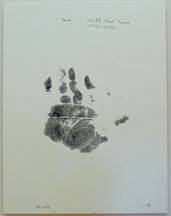
Longe. The painting, entitled Left Hand, is currently on view in the Museum’s third floor
galleries.
“This is a
significant gift and the first major painting by Jenny Holzer to
come into the Museum’s collection,” said Museum Director Mark H.
C. Bessire. “We are thrilled with Kevin’s desire to bring great
art to the Museum and to help us build a significant contemporary
collection.”
Left Hand features an enormous
handprint below an enigmatic hand-written inscription that gives
the name of an Iraqi detainee who died in Abu Ghraib prison. Like
other works in her Protect Protect series, Left
Hand is taken from previously classified documents made
public by the United States Government. When Holzer exhibited
works from this series at the 2007 Biennale in Venice,
she observed that, “People find them sad. The prints from the
detainees are post-mortem, and it is ghastly to take a dead man’s
hands and yank them down to make prints. That’s why those
handprints are distorted.” While the subject matter is difficult,
Holzer’s paintings have elements that are in the spirit of Pop and
contemporary artists, such as Andy Warhol and Gerhard Richter,
whose work raised difficult subjects to high art.
Holzer’s
identity as an artist has been closely linked to her use of
language, specifically aphorisms, that she carves in granite
benches, displays as large LED signs, and projects in public
spaces. In December 2010, in celebration of the 10th anniversary
of the Nelson Social Justice Fund lecture series at the Portland
Museum of Art, the Museum commissioned a projection by Holzer for
the Museum’s façade. This site-specific work, For
Portland , featured selections from the poetry of Nobel
Prize-winner Wisława Szymborska. The projection was on view for
one night only and was a crowd-stopper for downtown Portland. The
Museum also owns a small set of Holzer sayings printed on wooden
postcards, one of which reads: “Protect me from what I want.”
In
presenting the gift to the Museum, Kevin said he chose the
Portland Museum of Art for “its desire to build a contemporary
collection for which this piece could serve as a cornerstone for
attracting other internationally recognized art, the interest and
enthusiasm of the museum staff and the Portland, Maine community
in the arts, as well as the Museum’s emphasis on social justice
through the Nelson Social Justice Fund. I wanted the painting,
which was first exhibited at the 52nd Annual Venice Biennale, to
go to a museum where it could have the greatest impact.”
K evin
Longe is a avid supporter of the Portland Museum of Art and
president of ThermoSafe Brands. In January 2010, along
with the Jenny Holzer painting, Longe loaned the Museum three
major works of contemporary art by Richard Serra and Ellsworth
Kelly. The three works are all black and white and large in scale,
with each featuring a distinctive surface that engages the visitor
in different ways—politically, thematically, and aesthetically.
(Image
credit: Jenny Holzer (United States, born 1950), Left Hand
, 2007, oil on linen. Portland Museum of Art.)
Exhibits:
FIRST MUSEUM RETROSPECTIVE FOR LOIS
DODD ON VIEW THIS WINTER AT THE PORTLAND MUSEUM OF ART
Lois Dodd is best known for her works
in which she paints the world around her—from her apartment
windows in New York City to the woods and gardens of Maine and
New Jersey. The exhibition Lois Dodd: Catching the Light
is the first career retrospective for the painter and features
more than 50 paintings from six decades. The exhibition will be
on view January 17 through April 7, 2013, at the Portland Museum
of Art.
Born in 1927 in Montclair, New Jersey, Dodd first moved to New
York as a student at the Cooper Union. She studied there from
1945 to 1948, a time when New York emerged as the postwar art
capital of the world and Abstract Expressionism flourished. In
1952, she was the only female co-founder of the Tanager Gallery,
along with artists Philip Pearlstein and Charles Cajori, among
others. Rather than turn to abstraction, minimalism, or Pop,
Dodd has remained faithful to painting her immediate
surroundings throughout her career, whether it be a country
landscape or an interior view of her apartment.
Dodd was a key member of New York’s
postwar art scene and later taught at Brooklyn College for 25
years. She also found a second home in Maine and became
associated with the Lincolnville artists, including Alex Katz
and Neil Welliver, before moving to Midcoast Maine where she has
lived and painted for several decades.
Dodd was part of
the wave of New York modernists to explore the coast of Maine in
the later half of the 20th-century. Like Fairfield Porter,
Rackstraw Downes, Alex Katz, and Neil Welliver, Dodd started
spending her summers in Maine, beginning in 1951. Attracted by
the inexpensive but rambling old farmhouses, endless woods,
stone quarries, and the bright sunshine, Dodd and her fellow
artists sought both companionship and escape from the demands of
city life. At one time, Dodd shared a house with Alex Katz who
refers to Dodd’s work as, “fresh, honest, direct” in the
exhibition catalogue. To this day, Dodd can be found trekking
through the fields and forests in her Maine environs with canvas
and paint supplies in hand.
She often works
en plein air, starting paintings on site in the woods or
other location and finishing them in her studio. In her essay,
exhibition curator Barbara O’Brien writes, “Her paintings are
premised on the truth that she stood in this place, with the
light casting shadows just so, the temperature of the air warm
or cool, the sun warm against her face, protected by the brim of
a straw hat; her fingers able to employ brush to linen against
the wind of a New Jersey winter.” At times, her observations are
so direct that she uses the window to frame her compositions, as
seen in the exhibition’s View of Neighbors House in Winter.
Dodd often
returns to the same location and views to explore at different
times of day and times of year. Lois Dodd: Catching the
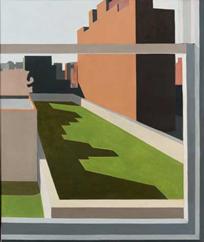
Light includes views of a men’s shelter outside her Lower
East Side apartment that become studies of light, architecture,
and the city. In Men’s Shelter, April, 1968, one sees
the verdant grass of spring with shadows cast by the surrounding
architecture of the neighboring buildings, depicted through her
flat blocks of color. Artist Will Barnet described Dodd’s work
by noting that, “she has this broad imagery and also this
ability to do different subjects and give them what was
important in that particular moment. She has an extraordinary
body of feeling about the possibility of imagery that can be so
different from each other, yet each a work of art, which is not
easy to do.”
Dodd is a member
of the American Academy of Arts and Letters and the National
Academy of Design, and a member of the board of governors for
the Skowhegan School of Painting and Sculpture. Among many
honors, she recently was awarded the Benjamin West Clinedinist
Memorial Medal in 2007 from the Artists’ Fellowship, Inc. and
Cooper Union’s Augustus Saint-Gaudens Award for professional
achievement in art in 2005. Her works can be found in museums
including New York’s Metropolitan Museum of Art; the Kemper
Museum of Contemporary Art, Kansas City, Missouri, and Portland
Museum of Art, Maine, among others. Dodd currently resides in
both New York and Maine.
The exhibition
is curated by Barbara O’Brien, director and chief curator at the
Kemper Museum of Contemporary Art. Jessica May, Curator of
Contemporary and Modern Art, will install the exhibition at the
Portland Museum of Art.A scholarly catalogue
accompanies the exhibition Lois Dodd: Catching the Light
includes essays by Alison Ferris, Barbara O’Brien, and John Yau,
and 51 color plates and 26 illustrations. In the essays, Ferris,
curator at the John Michael Kohler Arts Center in Sheboygan,
Wisconsin, focuses on Maine and its influences on the artist’s
work. O’Brien discusses the artist’s environment and subjects.
Yau, poet, art critic, curator, and professor at the Mason Gross
School of the Arts at Rutgers University, examines her work in
New York. The catalogue also includes personal reflections on
the artist by Will Barnet, Frances Barth, Charles Cajori, Wolf
Kahn, Alex Katz, Leslie Land, Mel Leipzig, Carl Little, Norma
Marin, Elizabeth O’Reilly, and Philip Pearlstein. The catalogue
is $40 and available in the PMA Store.
This exhibition
was organized by the Kemper Museum of Contemporary Art, Kansas
City, Missouri. Media sponsorship is provided by WCSH 6.
(Image Credit: Lois Dodd, Men's Shelter,
April, 1968, oil on linen, 47 1/2 x 39 1/4 inches; Kemper
Museum of Contemporary Art, Kansas City, Missouri; Bebe and Crosby
Kemper Collection, Museum Purchase made possible by a gift from
the Kemper Foundations.)
RELATED PROGRAM
Lois Dodd in Conversation with
Karen Wilkin
Wednesday, January 16, 2013, 5 p.m.
to 6 p.m. Holiday Inn By the Bay, Tickets: $10/Free for
members. Purchase tickets at portlandmuseum.org
This program features artist Lois Dodd
in conversation with art critic Karen Wilkin. Lois Dodd was a
key member of New York’s postwar art scene and part of the wave
of New York modernists to explore the coast of Maine in the
latter half of the 20th century. Dodd will be in conversation
with Karen Wilkin, a regular contributor to The New
Criterion, Art in America, and the Wall Street
Journal and Contributing Editor for Art for the Hudson
Review. The two will discuss the evolution of the art
scene in New York and Maine, and the ways the two locations
continue to inspire the artist. Afterward, Museum members are
invited to join the opening celebration to the retrospective
exhibition Lois Dodd: Catching the Light.
This
program is made possible in part by the Beatrice Gilmore Fund
for Museum Education.
VOICES OF DESIGN: 25 YEARS OF
ARCHITALXCELEBRATES
ARCHITECTURAL DESIGN AT THE PORTLAND MUSEUM OF ART
Voices of Design: 25
Years of Architalx will showcase the power of design
through an interactive exhibition featuring work of some of the
world’s leading architects and designers. On view February 2
through May 19, 2013, at the Portland Museum of Art, Voices
of Design will celebrate 25 years of Portland’s Architalx
lecture series.
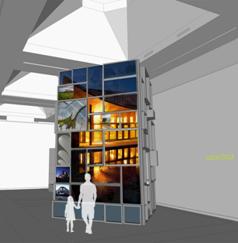
Voices of Design will include a 17-foot-tall
tower with three levels of images that alternately reveal
themselves and disappear. A dynamic image projection
will light up two sides of the tower by using projectors
embedded in the interior of the tower and will feature infrared
light sensors, creating touch interactivity for visitors. The visitors’ touch will
cause a rippling response of images on a massive scale and
connected to 12 architectural themes: Nature, Place, Expression,
Material, Process, Responsibility, Light, Structure, Space,
Craft, Optimism, and Culture.
On either side of the tower
will be two 10-foot-tall sound portals with thematic audio clips
from the Architalx lecture series. Through the use of
“holosonic” technology for projecting tight beams of sound, the
sound will be heard only by the person or persons in the
portals.
The exhibition will highlight
the cutting-edge work of leading architects and designers from
around the world who have presented as part of the Architalx
lecture series in Portland during the last 25 years, including:
Glenn Murcutt, Rafael Moneo, Tod Williams, Billie Tsien, Peter
Bohlin, Jim Cutler, Michael Van Valkenburgh, Ada Karmi-Melamede,
Samuel Mockbee, Brian MacKay-Lyons, Brigitte Shim, Merrill Elam
and Henry N. Cobb, among others.
The Voices of Design
tower was designed by architects Tim Ventimiglia and Jennifer
Whitburn of Ralph Appelbaum Associates, New York, with the
multi-media interactivity created by the international team of
Raphael DiLuzio, artist and Associate
Professor of Design Science/Fine Art at the University
of Southern Maine in Portland, as well
as an Apple Distinguished Educator, and Matthias
Oostrik, an interactive video artist based in Amsterdam, with
contributions by Andrew Bradley, structural engineer with SMRT
in Portland. Voices of Design was curated by Robert
Wolterstorff, Director, Bennington Museum of Art, Vermont and
John Turk, Principal, ttl-architects, LLC.
Architalx is a non-profit
volunteer organization established in 1987 for the purpose of
providing educational programs in the field of architecture and
design to Greater Portland and Maine. The mission of Architalx
is to broaden the awareness and understanding of architecture,
landscape architecture, and design by sponsoring activities
which foster evocative and creative dialogue within the design
community and with the general public. The Architalx board of
directors is composed of design professionals and others
interested in the built environment. For more information, visit
www.architalx.org.
The Voices of Design
exhibition underwriter is Marvin Windows and Doors,
distributed by A. W. Hastings and Company. CBRE/The Boulos Company is a Visionary Voice of
the exhibition.Sponsor Voices are
Wright-Ryan Construction, Duratherm Window Company and Studio
Mnemosyne. Patron Voices include SMRT, Inc., Doug Green, Green
Design Furniture, and Heidi Dikeman, GoGo Design. The media sponsor is Maine Home + Design. Voices of Design is a recipient of
a 2011 Davis Family Foundation grant.
(Image credit: Ralph Appelbaum Associates)
ARTIST MILDRED BURRAGE’S YEARS IN FRANCE AT THE PORTLANDMUSEUM OF ART
This spring, the Portland
Museum of Art will present From Portland to Paris: Mildred Burrage’s Years in
France , an
exhibition devoted to the work of Portland-born artist Mildred
Burrage (1890-1983), who as a young aspiring painter traveled to
Giverny,
France in the early 1900s. On view
April 21 through July 15, 2012, the exhibition will feature
more than 70 works of art including paintings, drawings, and
never-before-exhibited letters from a collection of works given
to the Museum in the 1980s as well as works on loan from private
collectors.
While
Mildred Burrage was a prolific artist up until her death in 1983,
this exhibition will celebrate the crucial, formative years
(1909-1914) of her life when she traveled abroad and was
introduced and exposed to modern European movements. There,
Burrage trained her eye on the landscape, creating oil paintings
and filling sketchbooks with images in her distinctive
Impressionist style. She wrote copious letters to her family back
in Maine, detailing
her adventures and providing vivid accounts of the artists,
dealers, and distinguished figures whom she encountered, including
French artistic legend Claude Monet and avid collectors Gertrude
and Leo Stein. The exhibition will reflect this unique time of
innocence, ebullience, and optimism in Mildred Burrage’s life and
career, and in the American and European psyche before the onset
of the First World War.
Many of the
letters in the exhibition, carefully transcribed by Maine State
Historian and co-curator of the exhibition Earle G. Shettleworth,
Jr., are delightfully annotated with drawings and watercolor
sketches . The exhibition will
also include a special display evocative of a turn-of-the-century
artist’s studio and will feature works by other artists who
painted in Giverny represented in the Museum’s permanent
collection and on loan from private collectors.
Mildred
Burrage took her first art classes from Portland
artist Alice H. Howes. Encouraged by her family, Mildred continued
her art studies at Miss Wheeler’s School in Rhode
Island. Miss Wheeler owned a cottage
in Giverny, France,
and invited Mildred to spend the summer painting there in 1909.
Under the direction of Miss Wheeler and other painters in the
area, including American expatriate artist Richard Miller who
became her mentor, she painted countless paintings and sketches of
the landscape and of the French villagers whom she met. Her works
reflect the influences and inspiration of Miller as well as Monet,
with their portrayal of light and shadow, and use of fluid
brushwork and bright natural colors. She exhibited her works in
exhibitions in Paris
as well as submitted them to exhibitions back in the States. She
traveled widely throughout Europe until
1914 when the onset of the First World War brought her back to Maine.
Throughout
her travels in Europe, Mildred
enthusiastically recounted her adventures in postcards and letters
which she sent to her parents and sister back in Maine.
In a postcard from 1909, for instance, she described with delight
a day in her life painting in Giverny:
"The river is a good
deal wider than the Kennebec.
It is the loveliest country you ever saw, the red brown roofs,
the white houses, and the green fields. I have been painting all
the morning, and we are just going to begin again. Tell mama
Miss Wheeler said most encouraging things to me this
morning…Probably we are going to Paris Sunday. Notre Dame. I hope we will
be there for the music. I would give anything to have you here.
It is so new and such fun. Heaps of love from M. "
While this
exhibition will focus on the early moments in the artistic career
of Mildred Burrage, she went on to become a force in Maine
through to the end of her life. An active advocate for historic
preservation and a champion for the arts, she established the
Lincoln County Cultural and Historical Association and spearheaded
numerous preservation projects.
This project
is related to the exhibition The Draw of the Normandy Coast
(June 14-September 3, 2012) which will also be on view at the
Museum through the summer of 2012—both exhibitions will celebrate
the lure of northern France for American and European
artists.
The
exhibition is curated by Margaret E. Burgess, The Susan Donnell
and Harry W. Konkel Associate Curator of European Art at the
Portland Museum of Art, and Earle G. Shettleworth, Jr., Maine
State Historian. A full-color catalogue will be published with
this exhibition.
This
exhibition is supported by Sally Wallace Rand, William G.
Waters, and by Wilmont and Arlene Schwind in honor of Sally
Wallace Rand. Corporate sponsorship is provided by The Bear
Bookshop, Marlboro, VT.
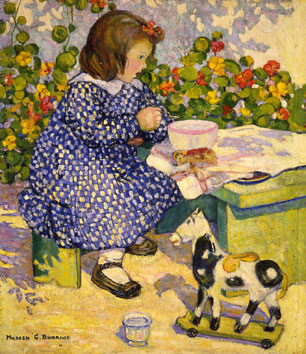
(Image Credit: Mildred Burrage, Souper
a Deux , 1909–1912, oil on canvas, 34 5/16 x 30 1/2
inches, Portland Museum of Art, Maine, Gift of the artist.)
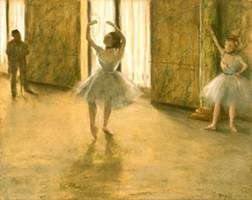
Edgar Degas: The Private Impressionistwill be
the first comprehensive exhibition in the history of the
Portland Museum of Art devoted to the 19th century French
master Degas and his works on paper. Comprised of more than 70
drawings, prints, pastels, and photographs as well as several
sculptures, the exhibition will provide an insightful
exploration of the oeuvre of one of the most skilled and
complex artists in art history. In addition to masterworks by
Degas, the exhibition will include a select group of 17 rare
works on paper by artists of his circle, including captivating
works by Mary Cassatt, Paul Cézanne, Jean-Auguste
Dominique Ingres, and Henri de Toulouse-Lautrec. Paintings and
drawings by Jane Sutherland, a contemporary New England artist
greatly inspired by Degas, will add yet another dimension to
the display.
*The Call
of the Normandy Coast (1820–1920) (first floor) June 7
through September 3, 2012
The northern coast of France—and Normandy in
particular—proved to be an artistic crucible for French and
American painters during the course of the 19th and 20th
centuries. Geographically convenient to Paris, accessible by
train, with dramatic cliffs and rock formations, and picturesque
and active ports, Normandy was an attractive haven. Realists,
Impressionists, Neo-Impressionists, Fauves, Cubists, and
Surrealists all gravitated to the area. Spanning roughly 100
years (1820–1920), this exhibition will chart the coast’s
significance and showcase the ways in which the landscape was
rendered by a spectrum of artists. This exhibition will explore
the importance of the towns and villages of Honfleur and Le
Havre, and such unique destinations as Étretat and will
feature more than 40 works of European and American art, mostly
paintings and works on paper, from the Portland Museum of Art
and from the private collection of Scott M. Black.
CELEBRITY PORTRAITS ON VIEW THIS WINTER AT THE PORTLANDMUSEUM OF ART
This winter, the Portland
Museum of Art will showcase its growing collection of celebrity
portraits, prompting a new look at the art of photographic
portraiture and highlighting two newly acquired portfolios of
works by artists Berenice Abbott and Robert Doisneau. Making Faces: Photographic
Portraits of Actors and Artists, on view January 14 through April
8, 2012,
will feature 35 black-and-white photographic portraits of
recognizable television personalities and famous artists.
The exhibition will reveal the sometimes surprising ways in which
appearance, poses, and props help to define the public perception
of an artist’s work—both on the stage and in the museum. Other
photographers whose works will be on view include Philippe
Halsman, with his ground-breaking images of notable early
television comics, such as Lucille Ball, Jimmy Durante, and
Imogene Coca, whose wildly expressive faces helped forge their
careers. Barbara Morgan’s photographs of the noted choreographer
Martha Graham further capture the essence of modern dance in
similarly exaggerated movements. The exhibition also includes a
close look at some of America’s
most
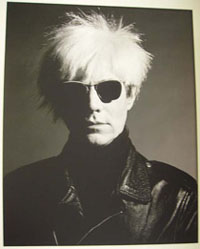
recognizable artistic personalities—Andy Warhol, Andrew Wyeth, and
Robert Indiana—masters of public relations, as well as the canvas.
In addition to
the faces of creative personalities, these photographs also
explore their art. Making Faces juxtaposes paintings,
drawings, and sculptures by leading European modernists such as
Pablo Picasso, Fernand Léger, and Jean Arp along with their
photographic portraits. Another gallery in the Museum will be
devoted to Maine photographer
David Etnier’s extensive portrait project that focuses on the work
of his father Stephen Etnier and his artist friends who have
dominated the Maine art scene for
the past 30 years. Among the group are portraits of some of Maine’s
favorite artists, both figurative and abstract, including Dozier
Bell, Alan Bray, Brett Bigbee, Jack Heliker, and Karl Schrag.
THE PORTLAND SOCIETY OF ART:
WINSLOW HOMER’S LEGACY IN MAINE ON VIEW THIS SUMMER
AT THE PORTLAND MUSEUM OF ART
This summer the Portland
Museum of Art presents The Portland Society of Art: Winslow Homer’s Legacy
in Maine, on
view July 28 through January 13, 2013. This exhibition
examines, for the first time, the artistic relationship
between the painter Winslow Homer, his close friend the
architect John Calvin Stevens, and the early years of the
Portland Society of Art, the precursor to the Portland Museum
of Art. With architectural drawings and a range of paintings
and watercolors by Winslow Homer and his Maine contemporaries,
this installation of 50 works provides a deeper understanding
of Portland’s art world at the turn of the last century.
The exhibition includes southern Maine
scenes by artists Charles Kimball, Vivian Akers, and George
Morse, Casco Bay seascapes by Harrison Bird Brown, and
watercolors by Mary King Longfellow. These paintings will be
installed next to contemporary pictorialist photographs by
William B. Post, Frank Laing, and other members of the Portland
Camera Club. Together, they place Winslow Homer’s art in a
regional context and they demonstrate how important his legacy
was for the burgeoning community of artists in Portland during
the early decades of the 20th-century.
Founded in
1882, just as the Homer family began to explore Prouts Neck for
its potential development as a summer community, the Portland
Society of Art sought to define a higher profile for the fine
arts in this city. The Society organized small exhibitions of
works by local artists, encouraged residents to display art
works that they had acquired in their travels abroad, and
promoted the new idea that photography was a fine
art.
A century ago, just after Homer’s
death in 1910, the Portland Society of Art opened its new art
galleries designed by the city’s leading architect, John Calvin
Stevens. The stylish Renaissance Revival building, known as the
Lorenzo de Medici Sweat Galleries, was intended to house the
Society’s growing collection of art by contemporary Maine
painters. Significantly, during the first three years of its
existence, the galleries also featured a small, but significant,
collection of works by Winslow Homer. Lent to the Society by
Homer’s brother, Arthur, the collection included 16 paintings
and watercolors. During those same years, 1911 to 1913, John
Calvin Stevens placed his Homer painting, The Artist’s
Studio in an Afternoon Fog,on public view for the first time. This romantic scene of
the rocks at Prouts Neck, shrouded in fog, silhouettes the Homer
family compound which Stevens had designed for them in 1883.
Alongside Homer’s work, the Portland
Society of Art’s early exhibitions also featured paintings by an
important group of local plein-air painters known as the “Brush
‘uns,” whose Sunday excursions were frequently led by Stevens.
Over the subsequent decades the Society acquired a
representative group of their landscapes and portraits, in
addition to a number of art photographs taken by members of the
Portland Camera Club, housed in the Society’s building. These
works came to form the core collection of the Portland Museum of
Art, when it was fully established in 1911.
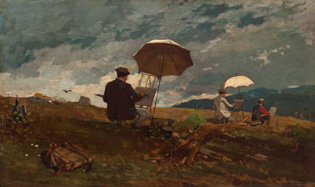
(Image credit: Winslow Homer (United
States, 1836–1910), Artists Sketching in the White
Mountains , 1868, oil on panel, 9 7/16 x 15 13/16 inches.
Bequest of Charles Shipman Payson.)
Hours:
Tuesday,
Wednesday,Thursday, Saturday and Sunday: 10 a.m. to 5
p.m.
Friday: 10
a.m. to 9 p.m.
Memorial Day
through Columbus Day: Mondays: 10 a.m. to 5 p.m.
Admission
& Directions:
$12 adults $10 seniors
and students with I. D. $6 youth 13 to 17 Children under 12 are free Free on Friday evenings
from 5 p.m. to 9 p.m., made possible through the
generous support of L.L.Bean and Patricia and Cyrus
Hagge. Membersare free. Membership is a
great value! Portland Museum of Art Members receive
free year-round admission, discounts in the PMA Store,
and the Members' Magazine.
PMA Café is
open Tuesday through Sunday from 10 a.m. to 4 p.m. and
Friday until 8 p.m. Memorial Day through Columbus Day,
open on Mondays from 10 a.m. to 4 p.m. No admission is
required to visit the Museum Café.
Open during regular Museum hours,
the PMA Store showcases products by Maine artists and
artisans including handcrafted jewelry, cards, home goods,
and gifts as well as Maine's largest selection of art
books, a children's section, and a variety of items
highlighting the Museum's collection and exhibitions.
Members receive a 10% discount. No admission is required
to visit the PMA Store.The
Museum Shop is
The
museum is located at Seven Congress Square in
Downtown Portland, at the intersection of High,
Congress, and Free Streets.
To
reach
the
Museum
from
I-295
(north
or
south),
take
Exit
6A, Forest Avenue South. Bear right at the first light,
drive through the park, and proceed on State Street to
the top of the hill. Turn left at the light onto
Congress Street. The Museum is located on the right
after the next light. Public parking lots are located on
High Street, Free Street, and Spring Street.
 The Portland Museum of Art
has received a painting by internationally known artist Jenny
Holzer from contemporary art collector Kevin Longe and his
family, daughter Kathleen Marie Longe and son Kelly Patrick
Longe. The painting, entitled Left Hand, is currently on view in the Museum’s third floor
galleries.
The Portland Museum of Art
has received a painting by internationally known artist Jenny
Holzer from contemporary art collector Kevin Longe and his
family, daughter Kathleen Marie Longe and son Kelly Patrick
Longe. The painting, entitled Left Hand, is currently on view in the Museum’s third floor
galleries.