HARVARD’S CENTER FOR THE TECHNICAL STUDY OF MODERN ART ANNOUNCES
LANDMARK GIFT OF BARNETT NEWMAN’S STUDIO MATERIALS
Gift from The Barnett and Annalee Newman Foundation is the Largest
Collection of the Artist’s Materials and Ephemera
Gift Makes Center Unparalleled Resource for Scholarship on Newman’s
Materials and Techniques and Will Further Enhance Center’s Teaching and
Research Initiatives unrivalled resource for scholarship on Newman’s
materials and techniques and establish the Center as the premier
resource for technical scholarship on Newman’s work.
The collection of tools (brushes, rollers, spray atomizer), materials
(paints, inks, glues) and other ephemera included in the artist’s
catalogue raisonné offers students, scholars, and the public
rare insight into Newman’s work and creative process. Among the
ephemera are unpublished sketches, discarded paint trials and Plexiglas
multiples, and cardboard models of his best-known sculpture, Broken
Obelisk (1963). Along with Newman’s paint-splattered studio hat and
shoes, painting table and ladder, these items provide a glimpse into
the artist’s private studio practice.
The Center for the Technical Study of Modern Art, one of four research
centers of the Harvard University Art Museums, investigates the
materials and issues associated with the making and the conservation of
modern works of art and serves as a resource for conservators,
scholars, and students by collecting, preserving, and presenting
relevant materials and research. In pursuit of its mission, CTSMA
collects and makes available for research artists’ materials, artists’
interviews, documents related to relevant conservation assessments and
treatments, and ephemera associated with the creative process. The
Center facilitates the dissemination of such information through
teaching, lecturing, and publication.
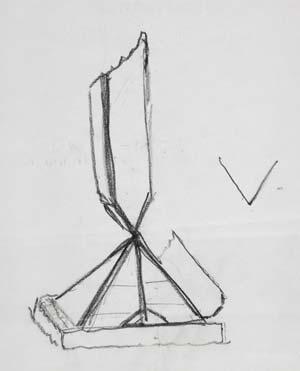
Barnett Newman, Untitled, c. 1963.
Graphite sketch on white printed stationery,
27.9 x 21.6 cm. Harvard University Art Museums,
Gift of the Barnett and Annalee Newman
Foundation, 2007.100.73.
Photo: Digital Imaging © President and Fellows of Harvard College.
CAMBRIDGE, MA (September 7, 2007)—The Center for the Technical Study of
Modern Art (CTSMA), a leading research center of the Harvard University
Art Museums, announces a major gift of Barnett Newman’s studio
materials and related ephemera through the generosity of The Barnett
and Annalee Newman Foundation. These materials, most of which have
never been seen outside of Newman’s studio, include painting tools and
supplies, damaged or unfinished paintings and multiples, drawings,
sketches, notes and models, as well as paint trials and canvas
fragments. The gift complements CTSMA’s existing archive of
correspondence and conservation treatment reports related to Newman, as
well as works of art donated to Harvard by his wife, Annalee Newman.
Together, these remarkable gifts create an sketches, discarded paint
trials and Plexiglas multiples, and cardboard models of his best-known
sculpture, Broken Obelisk (1963).
Along with Newman’s paint-splattered studio hat and shoes, painting
table and ladder, these items provide a glimpse into the artist’s
private studio practice.
The Center for the Technical Study of Modern Art, one of four research
centers of the Harvard University Art Museums, investigates the
materials and issues associated with the making and the conservation of
modern works of art and serves as a resource for conservators,
scholars, and students by collecting, preserving, and presenting
relevant materials and research. In pursuit of its mission, CTSMA
collects and makes available for research artists’ materials, artists’
interviews, documents related to relevant conservation assessments and
treatments, and ephemera associated with the creative process. The
Center facilitates the dissemination of such information through
teaching, lecturing, and publication.
This gift advances the Art Museums’ long-term interest in technical
studies and represents the first modern component to its material
collections that include the Forbes Collection of Pigments, the Gettens
Archive of Aged Pigments, and the Gluck Archives of British Artists’
Materials. As with these collections, Newman’s material will be used
for teaching by CTSMA, the Straus Center for Conservation, and the
History of Art and Architecture Department at Harvard University.
Accordingly, the Newman studio materials and related ephemera will be
catalogued and eventually made publicly accessible.
Born in New York City, Barnett Newman (1905–1970) was a leading member
of the Abstract Expressionist movement. He studied with Adolph Gottlieb
at the Art Students League in Manhattan and attended City College of
New York. After working as a substitute teacher in New York, Newman
launched an unsuccessful bid to become mayor of the city on a cultural
ticket. In 1946, Newman joined the Betty Parsons Gallery and in 1948,
he created Onement 1, often cited as “the beginning of [his] present
life.” The painting remains a seminal work in his oeuvre. Newman
continued to create abstract paintings defined by single vertical
bands, which he called “zips,” for the next two decades. After
suffering a severe heart attack in 1957, Newman painted steadily
through the 1960s and achieved critical recognition by representing the
United States at the Sao Paulo Bienal in 1965 and by exhibiting his
Stations of the Cross at the Solomon R. Guggenheim Museum in 1966.
Newman died of a heart attack on July 4, 1970. Now considered to be one
of the most influential painters of the Abstract Expressionist movement
in American art, Newman’s paintings and sculpture define a crucial
moment in the artistic and intellectual development of the 20th
century. The Barnett and Annalee Newman Foundation is a charitable
trust established in 2000 under the Will of Annalee Newman.
Carol Mancusi-Ungaro, the founding Director of CTSMA and Associate
Director of Conservation and Research at the Whitney Museum of American
Art, is co-author of Barnett Newman: A Catalogue Raisonné.
“Given my long association with the work of Barnett Newman,”
Mancusi-Ungaro said, “I am gratified that his studio materials will be
preserved and made available at the Harvard University Art Museums for
future generations of researchers. The items, many of which have never
been seen outside of Newman’s studio, offer rare and often critical
information about the material nature of his art. We are enormously
grateful to The
Barnett and Annalee Newman Foundation for recognizing the research
potential of this special collection and look forward to many years of
fruitful inquiry.”
“We are grateful to The Barnett and Annalee Newman Foundation for the
gift of this remarkable archive,” said Thomas W. Lentz, Elizabeth and
John Moors Cabot Director of the Harvard University Art Museums. “These
materials will play an important and continuing role in our teaching
and research initiatives on modern art. Barnett Newman’s exacting
technique and complex methods produced some of the most influential
paintings of the post-war period in American art, and we eagerly await
the insights of scholars as they make use of this rich resource.”
Back to Harvard
University Art Museums