Listing sponsored by
KappaElastin™
Scientific
Breakthrough.
No Shots
Science response to skin aging.
www.kappaelastin.com
Routee 28 North
& Route 30
Blue Mountain Lake, NY
Phone: 518-352-7311 --
TTY:
A regional museum of history and art, the Adirondack Museum's 22 indoor and outdoor exhibit spaces are situated on 32 landscaped acres, offering spectacular mountain and lake views. The museum’s extensive collections give visitors the opportunity to experience how people have lived, worked, traveled and played in the Adirondacks since the 1800s. Exhibit themes include: boats and boating, land transportation, outdoor recreation, the environment, logging, rustic traditions, fine arts, and tourism. Works of art by Arthur Fitzwilliam Tait and extraordinary wildlife photographs by Hobart V. Roberts will be featured in 2011.
Interactive discovery centers and hands-on activities abound throughout the museum, making the museum a fun place for families with children to play and learn. Watch the Boat Builder in Residence construct a traditional Adirondack guideboat, take part in a workshop, feed the fish, or participate in a field trip.
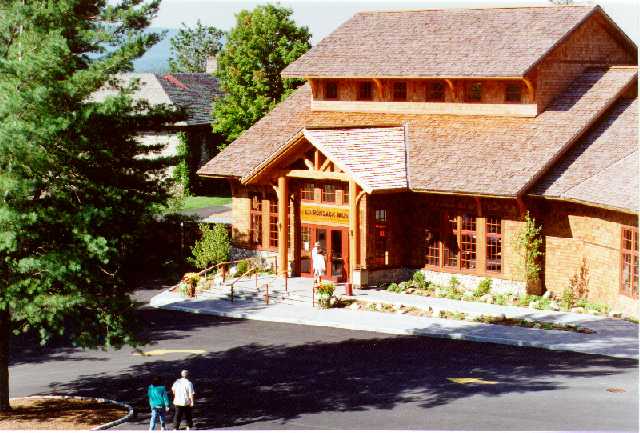
Services at the Adirondack Museum include the Lake View Café, open 11am to 4pm daily, overlooking pristine Blue Mountain Lake. Picnic areas are scattered throughout the grounds. Be sure to visit the Museum Store in the Visitor Center for a variety of Adirondack related gifts.
The museum provides a full schedule of events, programs, and lectures throughout the year. For details visit www.adirondackmuseum.org
When did trains come to the
region? What was it like to live in a lumber camp? Who were the
boat builders? Who dug for iron ore? When was there a horse in
every barn?
Long-term exhibits at the Adirondack Museum answer these questions
and many more. They introduce visitors to the cultural history of
people who lived in and visited the Adirondacks from the 1800s to
the mid-1900s and explore the impact of the Adirondack landscape
on peoples' lives and minds.
Twenty-two
buildings
and indoor/outdoor exhibits, on grounds surrounded by native
trees and flowers,
show how people have lived, moved, worked, and played in the
Adirondacks. Ongoing interpretive programs link past
with present. Here you’ll find the small wooden boats
crucial for work and transportation in a region laced with
rivers and lakes; you’ll find buckboards and elegant
sleighs, stagecoaches, a Model T Ford, and a mahogany
paneled private railroad car fit for the wealthy landowners
who built sprawling Adirondack retreats called “Great
Camps”. You’ll find exhibits exploring the region’s
main industries – logging, mining and tourism. You’ll
see a hermit’s camp, a one-room schoolhouse, a cottage
decorated entirely with mosaic twigwork, a large collection
of innovative rustic work and furniture, and the sleek lines
of the indigenous and renowned Adirondack guideboats.
Camping in the woods, surveying, hunting, skiing, trapping,
and other evidence of human endeavor since the 1800s are all
noted in museum exhibits. An exciting new
Visitors Center with Museum Store, and the Lake View
Café will complete your visit.
Allow 2 – 3 hours for a relaxing visit.
Temporary exhibits generally run for one or two years, and allow the Adirondack Museum to present a wide range of cultural and historic topics which supplement its long-term exhibits.
A full listing of the demonstrations, lectures, workshops and special events scheduled for 2003 is available on the museum’s website: www.adirondackmuseum.org.
The Temporary exhibits are:
“A Paradise for Boys and Girls: Children’s Camps
in the Adirondacks”
This exhibit explores the nature of Adirondack children’s camping
and how it has changed over time. The exhibit focuses
particularly on what distinguishes children’s camps in the
Adirondacks from camps elsewhere, the impact of camps on the
region, how the elements of children’s camps have been important
in youth development and how those elements have changed.
Over 270 children’s camps have been active in the Adirondacks
since the late 1800s when the children’s camps movement began,
with at least 70 of these camps still in operation.
Artifacts collected from current and defunct camps, historic
photos, and oral histories will supplement the information
presented.
“Places of the Spirit: Photographs of Sacred Spaces
in the Adirondacks”
This is an exhibition of the work of four photographers
commissioned by the Lake Placid Institute for the Arts and
Humanities during the summer of 2001 to visually respond to sacred
sites – churches, synagogues, burial grounds and other places of
spirituality – within the Adirondack region. In the
Adirondacks as elsewhere, sacred objects and phenomena are set off
from ordinary, everyday life. The architecture and
furnishings of churches and synagogues including the materials
used to adorn and embellish inside and outside, like the boundary
markers of cemeteries, are signifiers for how a particular
community views and conducts its daily life and how it wishes to
leave that life “behind.” This exhibition of over 40
photographs records the past, beauty and loss from the
perspectives of architecture, history and photographic
representation to stimulate reflection, visual awareness, and
perhaps even action.
“Summering in the Adirondacks: The Artist’s Views”
This special thematic exhibit drawn from the painting, print, and
recreation collections will convey the widespread appeal,
historically and aesthetically, of the Adirondacks as a summer
place. This exhibit will include images and artifacts of
summer pastimes – boating, fishing, camping; places to go and
places to stay – Ausable Chasm, High Falls Gorge, the High peaks,
hotels, lakes; and beautiful views including masterworks from the
museum’s renowned painting collection.
“Living With Wilderness”
This exhibit introduces
the visitor to highlights of Adirondack history that are fully
developed in the permanent exhibits. The visitor will
learn about events and people who lived and worked in the region
and how their activities changed the wilderness. The
museum’s much loved photobelt is featured in the exhibit.
The continuous loop of images will once again provide windows
into past daily life in the Adirondacks and show the faces of
people who lived, worked, and played in the wilderness.
Open seven days a week
(except the day before the Juried Rustic Furniture Fair Show)
from 10:00 am to 5:00 pm.
Season runs from Memorial Day weekend, to mid October. We are then open the last 2 weekends in October.
Adults age 13 +: $15.00
Youth ( to 12): $8.00
Children 5 and under: FREE.
Admission goes for 2 consecutive days.
Group rates are available for groups of 15 or more.
The Adirondack Museum is
located on Route 30 at Blue Mountain Lake – two hours from
Albany, Utica, Plattsburgh,or Watertown. 75 minutes from
Lake George or Lake Placid.
John
Collins, Director
Do you have any additional
comments
concerning this site?
Do you wish to receive some information on how
to
get
your museum on the Museums Tour?